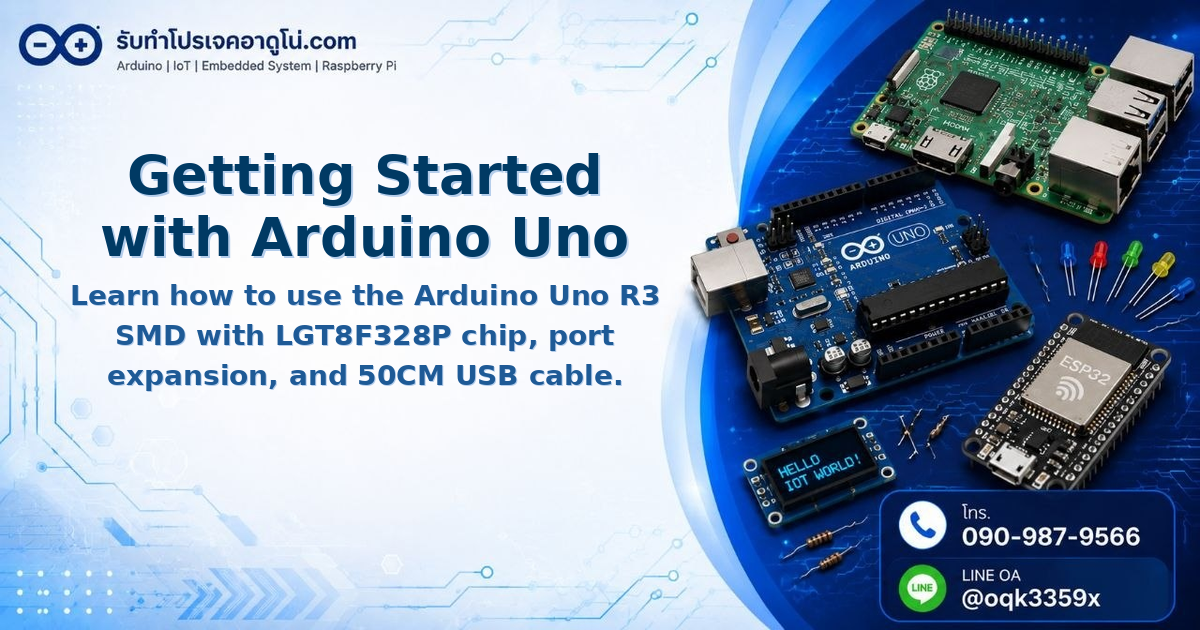
Getting Started with Arduino Uno R3 SMD LGT8F328P Board
Getting Started with Arduino Uno R3 SMD LGT8F328P Board
The Arduino Uno R3 SMD board with the LGT8F328P chip is a budget-friendly alternative to the standard ATmega328P version. It remains fully compatible with the Arduino ecosystem, making it a practical choice for learning digital electronics without a large investment.
What You Need
- Arduino Uno R3 SMD board (LGT8F328P chip)
- USB Type-A to Type-B cable, 50 CM length
- Computer with Arduino IDE installed
- Power Adapter 9V 2A with 5.5x2.5mm barrel jack (for power-hungry circuits)
How to Connect the Hardware
Method 1 - Connect to a computer for code upload and serial monitoring
USB Cable (50CM) → Arduino board → Computer
Method 2 - Connect Power Adapter for standalone operation
9V 2A Power Adapter → Barrel jack (5.5x2.5mm) on the board
Install Arduino IDE and Upload the Basic Sketch
These steps work for the standard Arduino family and the SMD variant with LGT8F328P chip.
Step 1 Open the Arduino IDE software.
Step 2 Delete all default text in the code window and paste the sketch below.
/*
  Blink - Arduino Uno R3 SMD (LGT8F328P)

  Turns on the on-board LED connected to digital pin 13
  for one second, then off for one second, repeatedly.

  Most Arduino boards have an on-board LED at pin 13.
  This example code is in the public domain.

  modified 8 May 2014
  by Scott Fitzgerald
*/

// the setup function runs once when you press reset or power the board
void setup() {
  // initialize digital pin 13 as an output
  pinMode(13, OUTPUT);
}

// the loop function runs over and over again forever
void loop() {
  digitalWrite(13, HIGH);  // turn the LED on (HIGH voltage level)
  delay(1000);              // wait for one second
  digitalWrite(13, LOW);    // turn the LED off by making voltage LOW
  delay(1000);              // wait for one second
}
Step 3 Select the Port where the board is connected. Go to Tools → Port and pick the COM port that represents your Arduino.
Step 4 Select the board type. Go to Tools → Board → choose Arduino Uno (no need to change to a specific LGT board setting, as this board is compatible with the Uno profile).
Step 5 Click the Upload button (right arrow icon) to compile and upload the sketch to the board.
Step 6 On the first upload, the IDE will prompt you to save the sketch. Give it a name and click OK. This dialog only appears for new sketches without a folder.
Step 7 Wait for the upload to complete. The time required varies depending on sketch size and board model.
Step 8 A successful upload shows “Done uploading” at the bottom of the IDE with no errors. On the board, the status LED will blink — on for 1 second, off for 1 second, repeating.
Key Points to Watch When Using This Board
Port expansion - This board includes expansion headers that add more I/O pins beyond the standard ones. This is useful for projects that need more digital and analog pins, but always verify your wiring before powering on.
Power supply - If you run modules or sensors that draw significant current, use a separate adapter instead of relying on USB power alone. Standard USB delivers only around 500mA, which may not be enough for multiple components.
Board selection in IDE - Select Arduino Uno as the board type. In most cases, no additional core installation is required for the LGT8F328P to work properly with the IDE.
Summary
The Arduino Uno R3 SMD with LGT8F328P chip works identically to the standard Arduino Uno in practice. The only difference is the processor chip, which is a compatible clone that works with Arduino IDE without special configuration. The built-in port expansion adds flexibility for connecting multiple devices, and the 50CM USB cable is long enough for typical desk-based experimentation.
อยากทำโปรเจคแบบนี้?
รับทำโปรเจค Arduino / IoT จบงานไว ส่งงานครบ พร้อมสอน
If you need Arduino project service or urgent IoT development, see full service details on the home page
จ้างทำโปรเจคเลย