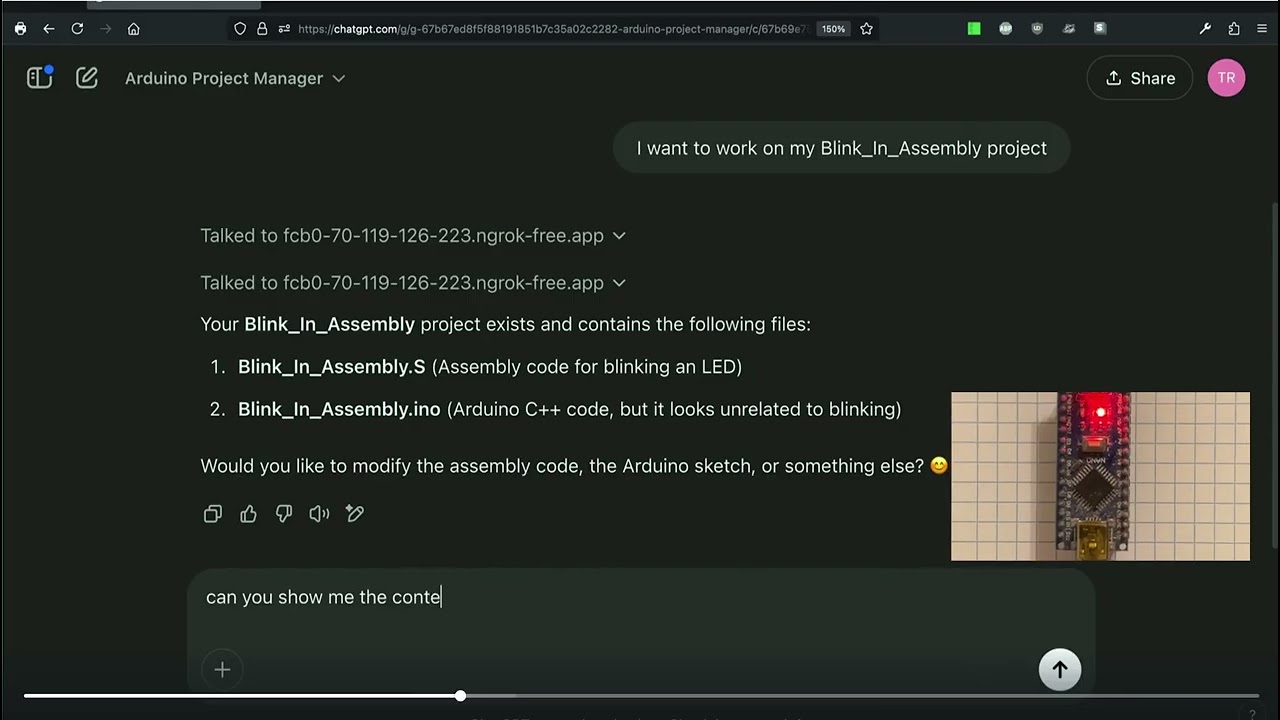
The Arduino Project Manager GPT isn’t a traditional hardware build—it operates at the bleeding edge of IoT integration. This project connects an internet-enabled ESP32 to OpenAI’s massive language models, turning a standard microcontroller into an incredibly smart conversational agent.
Securing the API Call
You cannot run AI models on an Arduino. Instead, you use the Cloud.
The Request: The ESP32 connects to Wi-Fi. It takes a text input (perhaps from a microphone converting speech-to-text, or a serial terminal input).
The HTTPS POST: The ESP32 crafts a highly secure, encrypted HTTPS request. It attaches your private OpenAI API Key, formats the question using JSON (JavaScript Object Notation), and sends it to api.openai.com.
The Wait: The Arduino WiFiClientSecure library waits for the server response.
The Parse: The ESP32 receives the massive JSON response back, uses ArduinoJSON to cut out the actual answer, and prints it to a screen!
Essential Parts Checklist
ESP32 or ESP8266 NodeMCU: Standard Arduinos don’t have enough RAM or HTTPS capability for this.
Micro-USB Cable.
A valid OpenAI API Key.
A Display: A large TFT or I2C LCD to read the AI’s responses.
This architecture forms the backbone of custom “Smart Home Assistant” projects, allowing you to ask your desk lamp complicated hardware questions and receive instant, articulate answers right on an LCD!