Thanks for checking out my first project!
This project is the definitive Masterclass in Persistence-of-Vision (PoV) Dynamics and Digit Multiplexing. The 4-Digit Text Scroller is a high-performance Visual Messaging System that proves how simple segments can be used to display complex, moving alphanumeric text. By cycling through individual digits at sub-millisecond speeds, the project creates the illusion of a continuous, scrolling display, delivering customized messages with professional cinematic fluidity.
How it works:
This program will quickly turn on and turn off digits sequentially in order to give the illusion that all the digits are on simultaneously. This is crucial to implement because the character that is being displayed cannot be tied to a particular digit.
For example, if I wanted to display the message "ABCD", Digit 1 will turn on and off displaying A, then digit 2 will turn on and off displaying B, and so on until all four digits have been displayed. Then the cycle refreshes.
If done correctly, the human eye will not be able to see when the microcontroller switches which digit it is displaying. This is due to the biological phenomenon of Persistence of Vision.
Visual Infrastructure and Multiplexing Architecture Overview
The 7-Segment Text Scroller functions through a specialized Multiplex-to-PoV lifecycle. The system is built on a Sequential Gating Logic. Standard 4-digit displays share 8 common pins for the segments (A-G and DP) but have 4 independent "Anode" (or Cathode) pins for each digit. To display "ABCD" on a display that can only show one character at a time, the Arduino:
- Enables Digit 1 -> Displays "A" -> Disables Digit 1.
- Enables Digit 2 -> Displays "B" -> Disables Digit 2.
- Repeats for all 4 digits at a refresh rate higher than 60Hz. The result is a flicker-free, 4-character message that appears steady to the human eye.
Hardware Infrastructure & The Optical Tier
- Arduino UNO R3: The "Timing Maestro." It handles the thousands of digital switches per second required to maintain the multiplexed output without noticeable lag.
- YSD-439AK2B-35 Display: The "Radiant Matrix." Featuring a common-anode configuration, it provides high-contrast Red illumination suitable for bright desktop environments.
- 1k Ohm Gating Resistors: Placed on the common anodes to protect the internal silicon from "In-Rush" current during the rapid switching cycles.
- 220 Ohm Segment Resistors: Ensure uniform brightness across all 7 segments of a digit, preventing "Hot Spots" or uneven luminosity.
- Breadboard Interconnect: Provides a stable logic bus for the complex wiring required to connect 12 pins between the display and the Arduino.
Circuit Schematic:
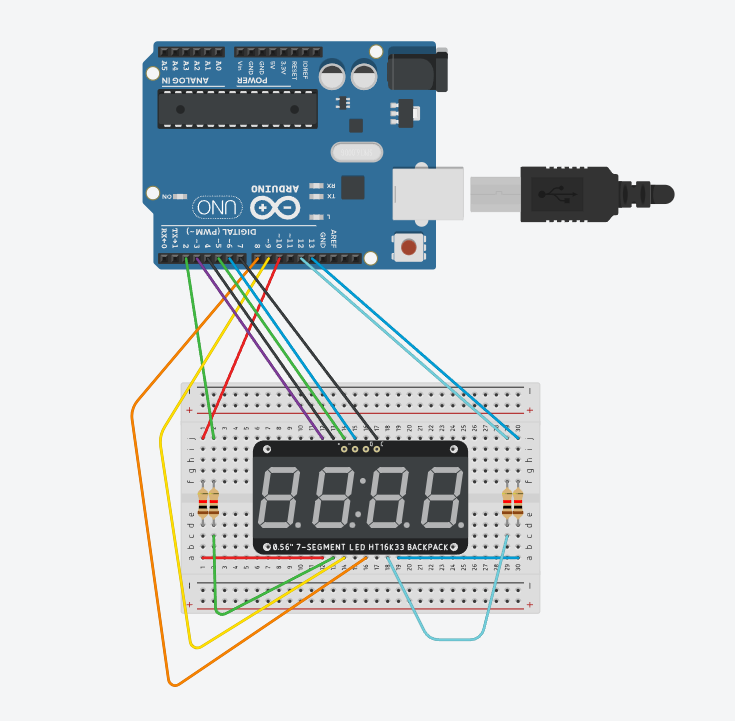
Technological Logic and Scrolling Algorithms
The system reaches high-fidelity animation through several Bitwise Decision Strategies:
- Bit-Map Character Generation: The code includes a custom translation library that maps letters like "A," "H," and "S" into the 8-bit segment patterns needed for the 7-segment hardware.
- The Array Buffer Scroll: The customized message is stored in an array. The code "Shifts" the starting index of this array over time, creating the "Right-to-Left" scrolling effect iconic to 80s-era computers.
- Micro-Delay Optimization: Using
delayMicroseconds(), the software tunes the "On-Time" of each digit to balance brightness with flicker reduction, finding the "Sweet Spot" for optical clarity. - Sequential Power Management: By ensuring only one digit is powered at any nanosecond, the project reduces the peak current draw from the Arduino, ensuring safe long-term operation.
Example Video:
Why This Project is Important
Mastering Multiplexing and PoV Animation is an essential skill for Display Engineers and UI Designers. It teaches you how to control high-information-density hardware while using a minimal number of GPIO pins. Beyond segment displays, these same principles are used in Professional LED Billboards, Dot Matrix Marquees, and VR/AR Refresh Rate Optimization. Building this scroller proves you can handle time-critical software loops and deliver a functional, dynamic communication tool for the modern embedded UI.