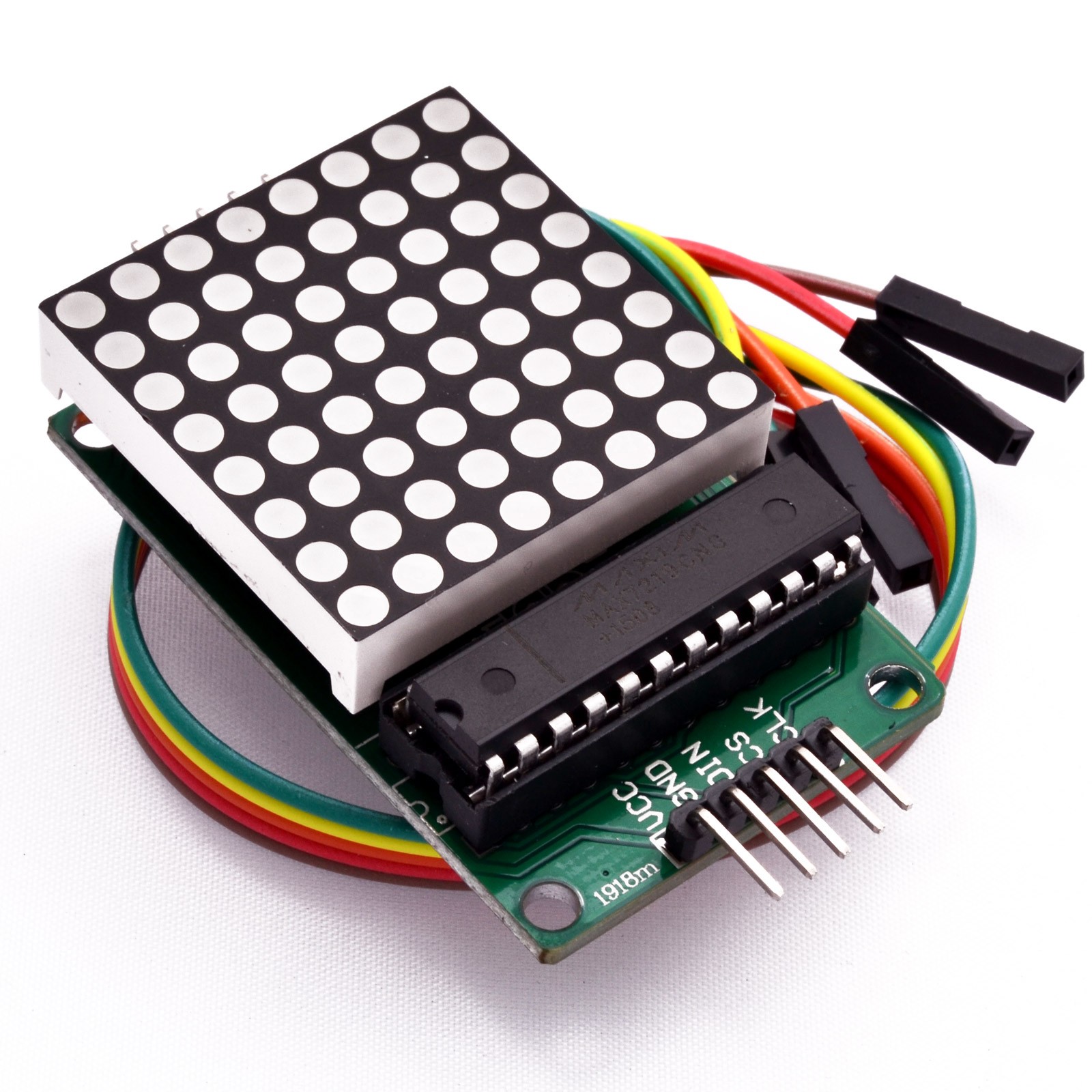
What's up guys, in this video, we will be working with the 8×8 LED Matrix module and displaying simple text or logos on the LED Matrix.
Full tutorial on my youtube channel
What is dot matrix display?
A dot-matrix display is an electronic digital display device that displays information on machines, clocks and watches, public transport departure indicators and many other devices requiring a simple alphanumeric (and/or graphic) display device of limited resolution.
Subscribe to my youtube channel
Follow me on instagram
Project Overview
"Matrix-Vision" is a rigorous exploration into Serial-Display Diagnostics and High-Frequency Multiplexing Forensics. While driving 64 individual LEDs $(8\times8)$ would typically exhaust the GPIO resources of an Arduino Nano, this project utilizes the MAX7219 driver to offload the visual orchestration. By leveraging the SPI-based communication protocol and custom bit-masking heuristics, Matrix-Vision functions as a high-fidelity visual telemetry node, capable of displaying alphanumeric data and custom bitmaps with sub-millisecond refresh harmonics.
Features:
- 8x8 RED common cathod dot matrix
- Operating Voltage: DC 4.7V~5.3V
- Operating Current: 320mA
- Max Operating Current: 2A
- Operating Temperature: 0~50 Degree
- 16 holes in total, hole diameter: 3mm
- Module with input and output interfaces
- Dimension: 12.8 x 3.2 x 1.3 cm
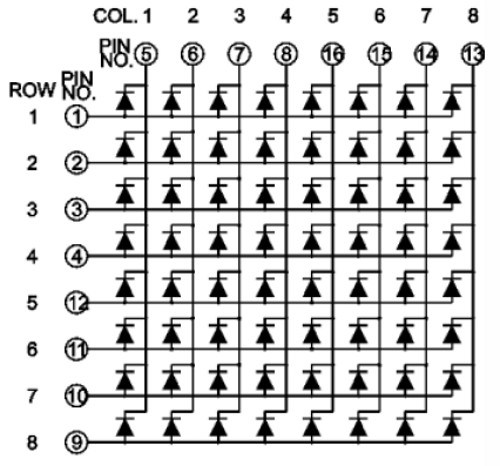
Pinout & Technical Deep-Dive
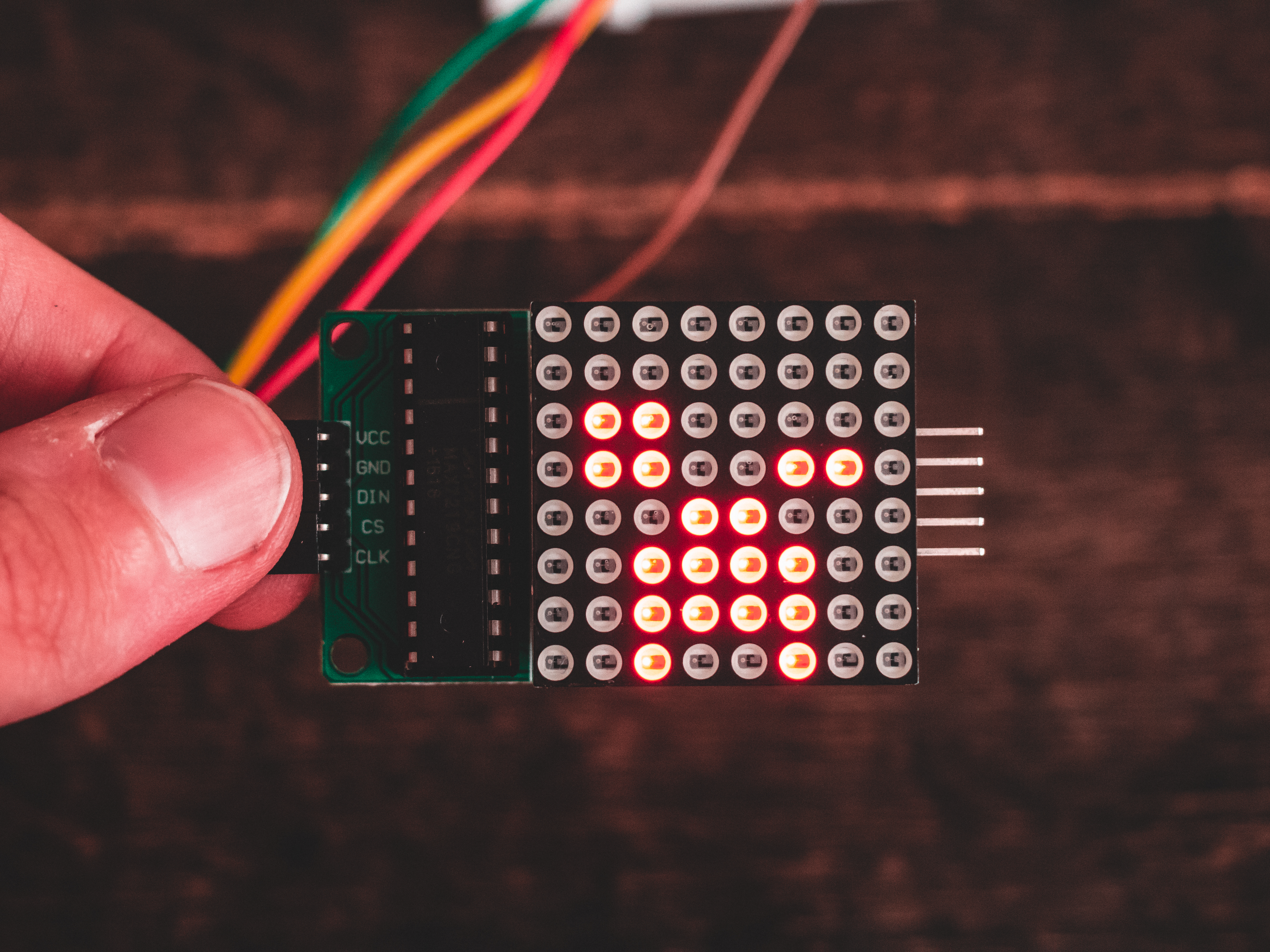
Pin Input Output 1------VCC (5V)-----VCC 2------GND-------- GND 3------Din----------Dout 4------CS-----------CS 5------CLK---------CLK
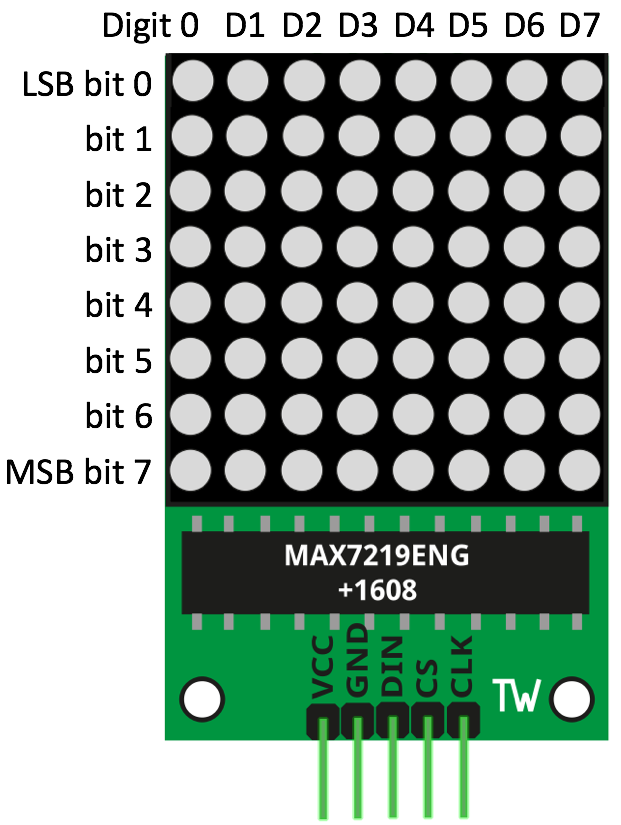
This 8x8 serial dot matrix LED module (HCOPTO0014) allows you to experiment with dot matrix LED's without all the complicated wiring. The module makes use of the MAX7219 serial matrix LED driver which handles all the complicated stuff such as multiplexing the LEDs and driving them at the correct currents. What's more, the modules can be daisy-chained to make larger LED displays whilst still only requiring 3 digital control pins. The PCB has no overhang on the sides of the matrix module so modules can be positioned side by side with no gaps to make one continuous display.
- MAX7219 Multiplexing Forensics:
- The Scan-Limit Diagnostics: The MAX7219 operates by rapidly switching between the 8 common-cathode rows $(\text{at } \approx 800\text{Hz})$. This "Persistence of Vision" diagnostics ensures that each LED appears constantly illuminated while only $1/8$th of the array is active at any given nanosecond. The forensics involves optimizing the "Intensity Register" $(0x0A)$ to balance photonic brightness against the thermal-stress constraints of the silicon die.
- SPI-Bus Daisy-Chain Orchestration: The module utilizes a 3-wire serial interface $(\text{DIN, CS, CLK})$. Forensics into the "No-Op" register $(0x00)$ allows for the daisy-chaining of multiple modules in a deterministic link. By shifting data through the $16$-bit internal registers of sequential MAX7219 chips, the system can expand into large-scale "Ribbon" displays without increasing the Arduino's pin-count forensics.
- Bit-Masking Character Forensics:
- The Bitmap Matrix Analytics: Each frame of the display is represented as a $64$-bit buffer $(\text{8 bytes})$. The forensics involves creating bit-masks for custom glyphs and logos. By mapping binary data $(\text{e.g., } 0b11000011)$ to specific row-registers $(0x01 \text{ to } 0x08)$, the firmware executes a high-speed buffer-dump to update the visual HMI with negligible latency.
Engineering & Implementation
- Power Integrity & Decoupling Forensics:
- Current-Spike Mitigation: Switching 64 LEDs causes high-frequency transient noise on the 5V rail. The project implements a dual-capacitor diagnostic strategy: a $10\text{µF}$ electrolytic for bulk reservoir support and a $100\text{nF}$ ceramic for high-frequency decoupling. This prevents "Voltage-Brownout" harmonics that could glitch the SPI communication link.
- Thermal-Budget Analytics: At maximum intensity, an $8\times8$ module can draw up to $320\text{mA}$ $(\text{continuous})$. Engineering diagnostics recommend using an external 5V source for daisy-chained arrays to prevent overloading the Arduino's onboard 5V regulator forensics.
- Visual Logic Orchestration:
- The implementation utilizes a modular software architecture. By abstracting the "Pixel-Set" logic from the "Character-Scroll" routine, the system can execute complex animations—such as marquee scrolling—through deterministic bit-shifting of the entire $64$-bit frame buffer.
Conclusion
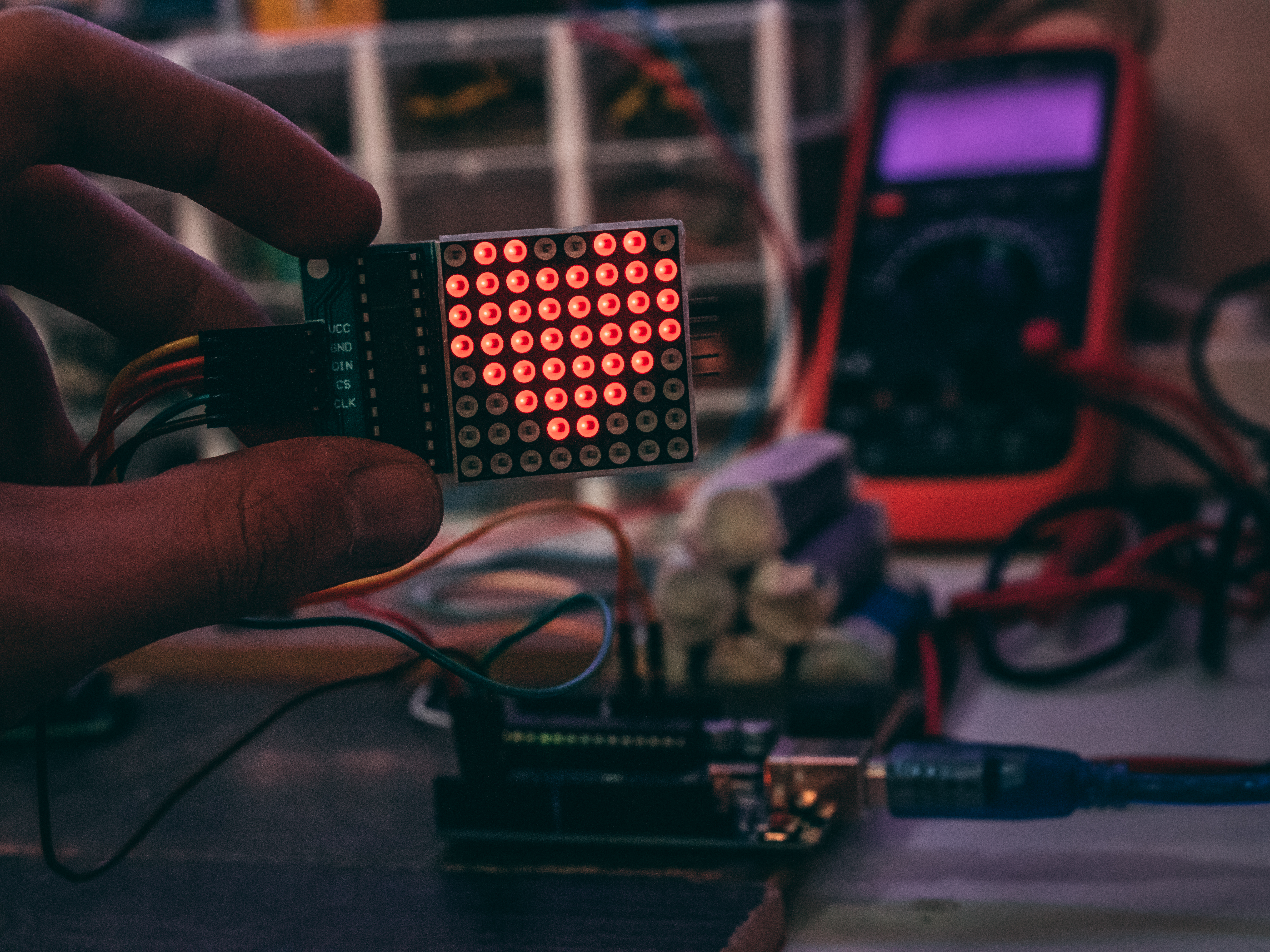
Matrix-Vision represents the pinnacle of Efficient Visual Computing. By mastering MAX7219 Forensics and Bit-Masking Diagnostics, CiferTech has delivered a robust, professional framework for building scalable LED-based HMIs with absolute resource efficiency.
Photonic Precision: Mastering matrix displays through multiplexing forensics.
Subscribe to my youtube channel
Follow me on instagram