Smartphone Steering: Android Controlled Robot
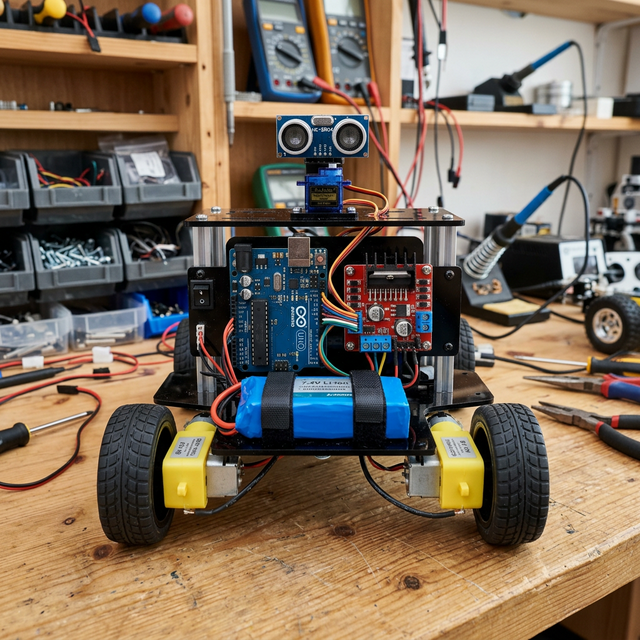
Line-following robots are entirely autonomous. The Android Controlled Robot Car relies completely on user inputs. It teaches the critical integration protocol of parsing massive streams of 1-byte Bluetooth character commands ('F', 'B', 'L', 'R') and routing that data instantly into a dual-bridge physical motor array to steer a moving chassis through obstacles.
The Character Stream Protocol (HC-05)
When you drag the joystick thumb-pad Forward on your custom Android screen, it doesn't just send one signal. It sends a chaotic stream of commands to the Arduino's HC-05 Bluetooth transceiver.
- The Trap: If the Arduino
loop()freezes for even 50ms while analyzing the code, the Bluetooth buffer overflows, and the car crashes into the wall! - You must utilize non-blocking Serial listening:
if(Serial.available() > 0){
  char command = Serial.read();
  if (command == 'F') { DriveForward(); }
  else if (command == 'L') { SpinLeft(); }
  else if (command == 'S') { HaltMotors(); }
}
The L298N Differential Steering Matrix
There is no steering wheel on this robot. It turns like a tank (Differential Logic).
- The L298N Dual-Bridge Driver runs both Left motors and both Right motors.
- The
SpinLeft()function does not slow the left wheel down. That is an inefficient turn. - To execute a violent, exact left-hand pivot:
analogWrite(ENA, 255); analogWrite(ENB, 255); // Full power via PWM digitalWrite(IN1, LOW); digitalWrite(IN2, HIGH); // Left Rack REVERSE! digitalWrite(IN3, HIGH); digitalWrite(IN4, LOW); // Right Rack FORWARD! - The car instantly stops driving and violently spins perfectly in a circle in place!
Rover Construction Core
- Arduino Uno/Mega + Sensor Shield for easy servo/bluetooth pin expansion.
- HC-05 or HC-06 Bluetooth Slave Module.
- L298N Motor Driver Interface Board.
- Massive 4WD Acrylic or Aluminum Robot Chassis Kit with four geared TT yellow DC Motors.
- Two separate power supplies: A 9V battery for the Arduino's delicate IC logic, and a massive 2-cell LiPo (7.4V) strapped explicitly the L298N motor driver! (Combining them into one battery often causes Arduino resets due to motor voltage spikes!).