This project is an Arduino-based interactive challenge, where the player must solve a color puzzle to “unlock” an imaginary crypt. Inspired by the concept of a mystical adventure, the system relies on an RGB LED, potentiometer and buttons to generate specific colors and validate a secret sequence. The project comprises four main modes:
- Button or Single mode : Activates red and blue colors independently. When combined, they form purple, symbolizing the opening of the safe.
- Mystic Code Mode : The user must reproduce a specific color sequence to unlock the safe (e.g. red, red, blue, red).
- Total Arcane mode : control the LED hue with a potentiometer to display all the colors of the rainbow.
- Forbidden Enigma mode : the LED flashes in Morse code to guide the user.
Materials
- 1 Arduino Uno
- 1 RGB LED (common anode)
- 3 Pushbuttons (one for red, one for blue and one for mode change)
- 3 220Ω resistors (to protect the LED)
- 1 Potentiometer (for Total Arcane mode)
- Jumpers and breadboard
Wiring diagram :
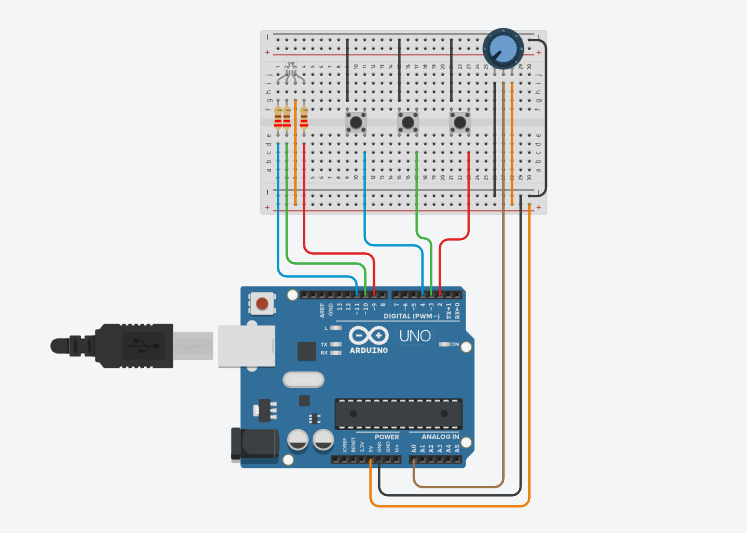
Technical Deep-Dive
- Chromatic Orchestration & Photometric Forensics:
- The RGB Logic-Hub: Utilizing Pulse-Width Modulation (PWM) on pins 9, 10, and 11 to achieve high-resolution color-mixing diagnostics. Forensics involve the measurement of the "Luminous-Intensity Balance"; the system maps 8-bit integers $(0-255)$ to individual diodes to produce specific spectral-harmonics. The diagnostics focus on "Photonic-Summation Analytics," ensuring that the simultaneous activation of Red and Blue nodes results in a discrete Purple safety-trigger.
- Temporal-Sequence Diagnostics (Mystic Code): The firmware implements a state-machine that captures asynchronous input-pulses. Forensics include the verification of the "Press-Sequence Fidelity"; the system compares the real-time buffer against a pre-defined cryptographic-vector (e.g., R-R-B-R) to trigger the "Unlocked" status-diagnostic.
- Analog Aesthetics & Telemetry Harmonics:
- The Potentiometer Signal-Probe: Utilizing a 10-bit ADC to modulate the mode-selection heuristics. Forensics include the mapping of the "Analog-Voltage Envelope" $(0-1023)$ across the HSV-to-RGB conversion matrix.
- Morse-Encoded Photonic Telemetry: Implementing the "Forbidden Enigma" mode, where the LED executes high-speed on-off keying forensics. The diagnostics focus on "Temporal-Duty-Cycle Analytics," translating Morse-code pulses $(.\text{ } .\text{ } .\text{ } -)$ into directional guidance-vectors.
Engineering & Implementation
- Input-Logic & Switch-Integrity Forensics:
- Asynchronous Handshake Analytics: Utilizing internal pull-up/down resistors (via hardware configuration) to maintain clean logical rails. Forensics include the measurement of "Contact-Bounce Jitter" to prevent false-trigger diagnostics during rapid puzzle-solving.
- PWM-Fidelity Diagnostics: The Arduino Uno maintains a $490\text{Hz}$ carrier frequency for the RGB nodes. Forensics focus on "Duty-Cycle Stability" to prevent visual flickering-harmonics during low-brightness chromatic-rasterization.
- Logic-Heuristics & Mode-Abstraction:
- The implementation utilizes a "Hierarchical Mode-Orchestration" architecture. Forensics include the measurement of the "Mode-Switch Latency" as the user transitions from button-driven logic to potentiometer-driven analog analytics.
Operating modes :
- Button mode Pressing the red button lights up the red LED only. Pressing the blue button lights up the blue LED only. Pressing both buttons at the same time lights up the violet color (red + blue).
- Mystic Code mode The user must enter a correct sequence of buttons (ex: red, red, blue, red). If the sequence is correct, the safe opens (RGB LED lights up purple). If the sequence is incorrect, the LED does not light up and the sequence is reset.
- Total Arcane mode The RGB LED displays all the colors of the rainbow, depending on the position of the potentiometer.
- Forbidden Enigma mode The LED flashes Morse code to guide the user. For example, it may display the letter “...-” for purple.
The mode is determined by the position of the potentiometer or by pressing the green button : Potentiometer at 0 → Button mode Potentiometer between 10 and 1000 → Total Arcane mode Potentiometer at 1000 → Forbidden Enigma mode Green button pressed → Mystic Code mode
Possible improvements :
Guardian of the Lost Lights mode: Add a more complex sequence where several buttons must be pressed in a precise order. Audio indications: Add a buzzer to indicate errors or successes. LCD display: Use an LCD screen to guide the user through the active mode and the steps to follow.
This project offers an interactive and educational experience using RGB LEDs and Arduino inputs. It's perfect for beginners wishing to learn about color management and push-button interaction. If you take up the challenge and improve the project, please share your results !😉