Holiday guests choose the colour of the lights on the outdoor tree. Family marvels at the Internet of Things (and how nerdy you are, see ulyssesandbloom.ca). Neighbours appreciate the scintillation of small sparks twisting in the wind.
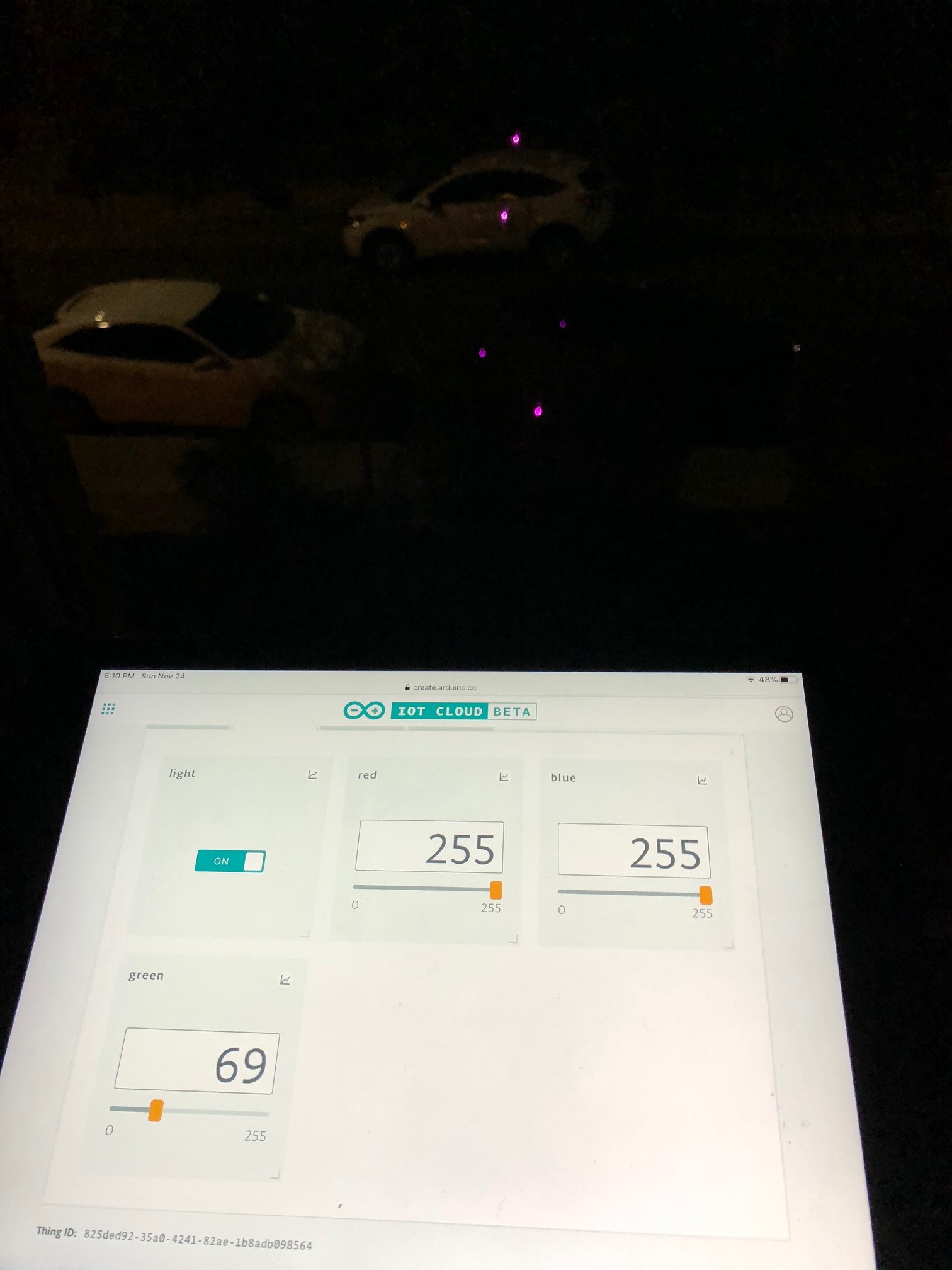

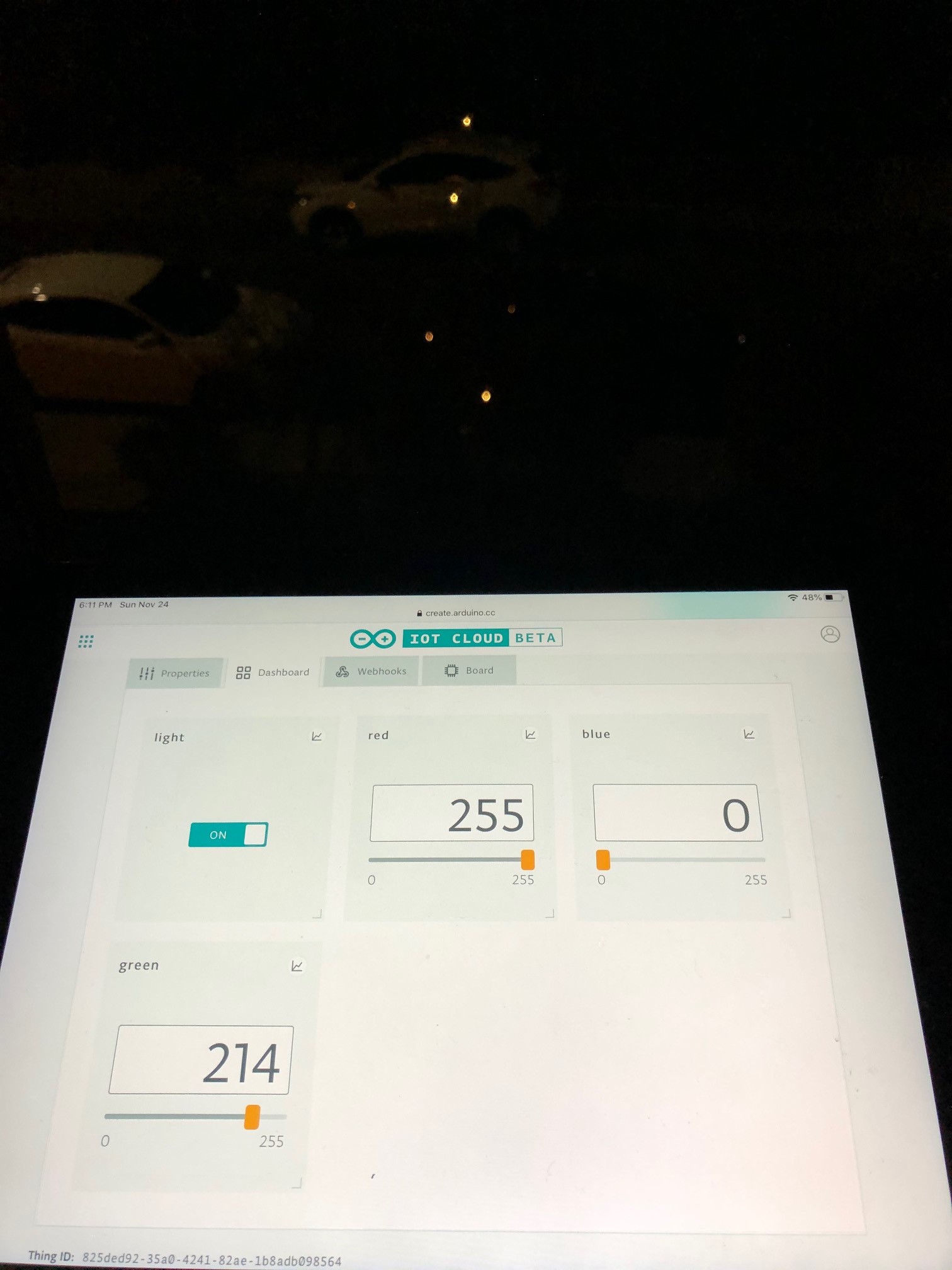
The Engineering Behind the Beauty: Why NeoPixels?
The core of this project is the use of NeoPixels (WS2812B Addressable RGB LEDs), which differ from standard decorative lights in that each LED has its own integrated circuit (IC) controller, allowing us to command each LED to display different colors independently via a single signal wire (Single-wire protocol).
From an engineering perspective, NeoPixels offer interesting features for outdoor tree decoration:
- High-Resolution Control: We can send 24-bit data (8-bit per Red, Green, and Blue color) to mix over 16 million shades.
- One-sided Structure: As the LED chips are flat and illuminate only on one side, when wrapped around flexible tree branches, the light emitted provides different dimensions depending on the vantage points.
- Weather Resistance: From real-world testing in this project, NeoPixels have proven durable in harsh weather conditions, including snowstorms and continuous strong winds for over a month. The lightweight wiring also facilitates easy installation on branches without causing damage to the tree.
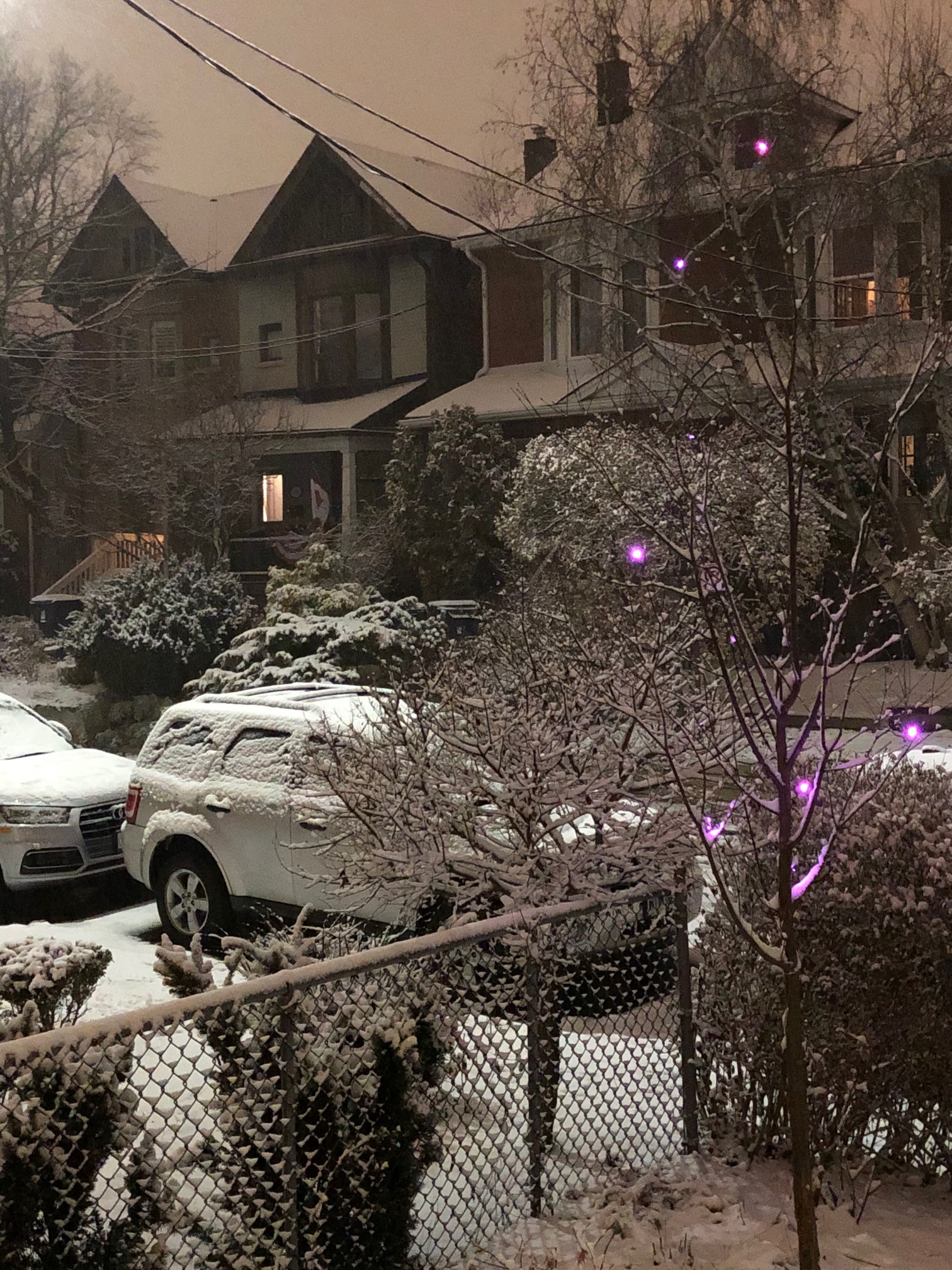
The NeoPixels held up over a month of snow and wind. Light wire makes them easy to place in the tree. Since NeoPixels are one-sided, different lights are seen from different vantage points.
The "Scintillation" Phenomenon: When Technology Meets Nature
The appeal of this project is not just its ability to change colors, but the "reflection and flickering caused by the wind." Because NeoPixels illuminate only on one side, when the wind blows through the branches and causes the light strips to rotate, the individual LEDs rapidly appear and disappear from the observer's sight, creating a small sparks effect that looks like lights dancing on the tree. This is a charm that conventional decorative lights cannot achieve. The display seems to change as you walk by. The pixels appear to be illuminated or extinguished as they rotate in the wind.

Operational Logic and IoT Connectivity
For the system to be controlled via the internet, we need a microcontroller with a built-in Wi-Fi module (e.g., Arduino Nano 33 IoT or ESP32). The operational process is as follows:
- User Interface (UI): Create a Dashboard comprising RGB Sliders (Red, Green, Blue) using an IoT platform (e.g., Arduino Cloud or Blynk).
- Data Transmission: When the user moves a Slider, a numerical value from 0-255 is sent via MQTT or HTTP protocol to the control board installed on the tree.
- Code Logic:
- The board will "Subscribe" or await changing values.
- Upon receiving new color values, a function in the code will map the Slider values to the
strip.setPixelColor(index, strip.Color(R, G, B))function. - The
strip.show()command will be invoked to update the status of all LEDs simultaneously, resulting in smooth and real-time color changes.
- Power Management: Due to outdoor use and a considerable number of LEDs, the system calculates sufficient current supply. A separate power supply from the microcontroller board is used to prevent voltage drop issues when the lights are at maximum brightness.
This project is therefore not merely about decorative lighting, but an application of embedded engineering and IoT knowledge to create the most creative interaction between people and places during the festive season.