DART-E
My son is 4. He loves building things and expects that I should be capable of building anything. This is my attempt to prove him right.
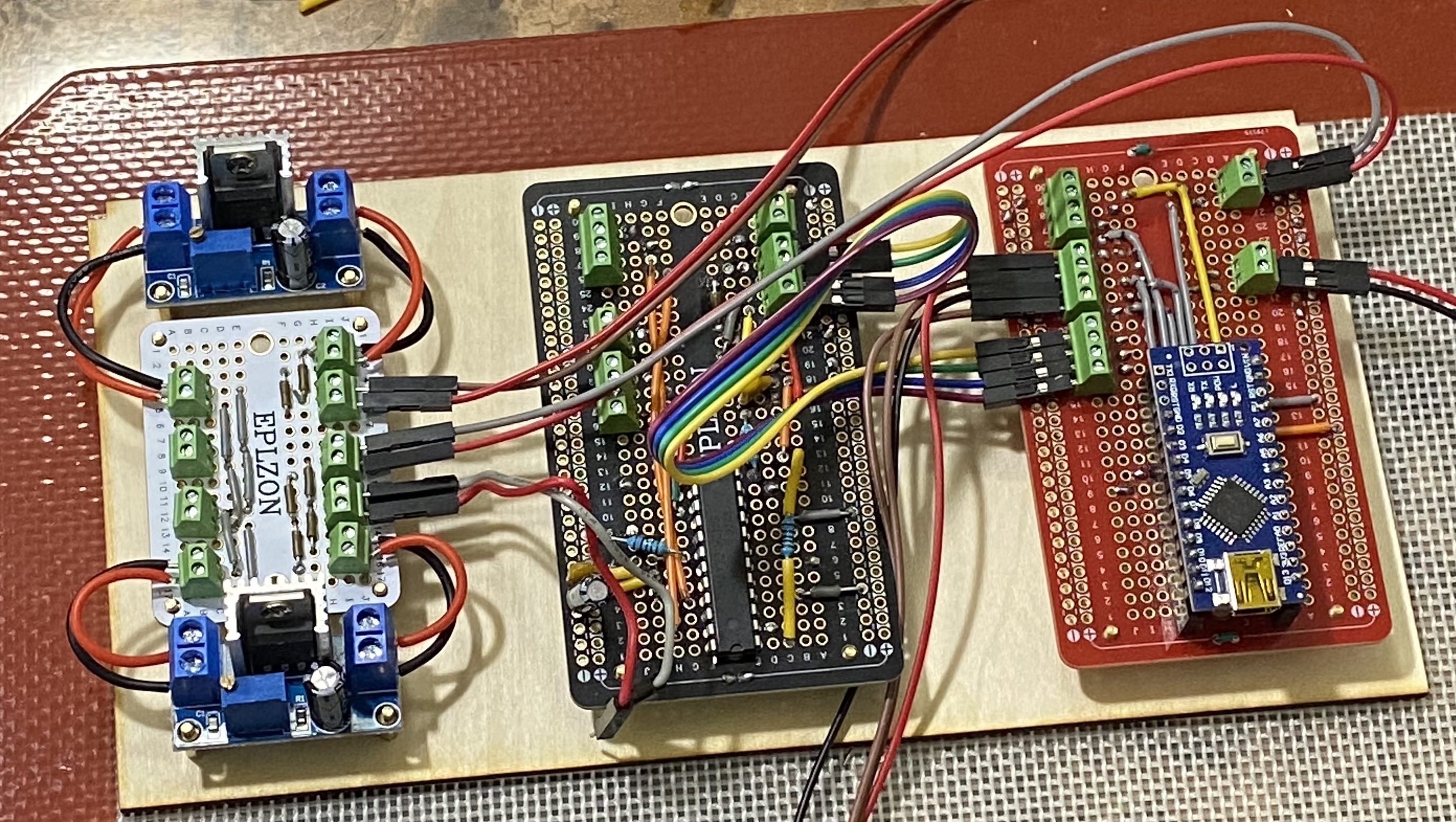
I am new to electronics, Arduino, and building stuff in general. I am typically a software guy. This project helped me and my son explore more intermediate projects where we had to consider voltage, current, and even flyback diodes to protect our circuit from the solenoid we used.
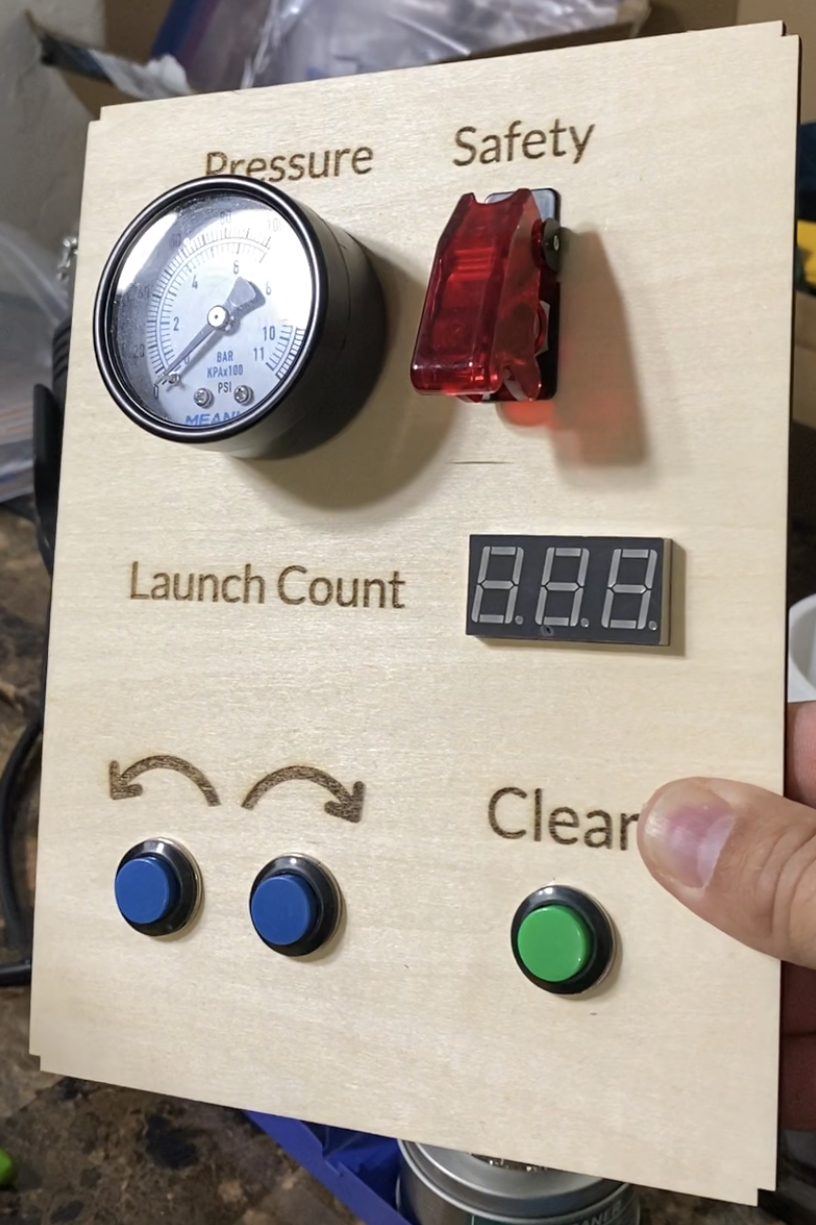
Additionally, we got to explore the use of our xTool laser cutter to add custom panels and a control board to our MakerBeam frame.
Huge thanks to the Arduino community, specifically to folks in Discord that helped me troubleshoot all types of nuance within our circuit.
The Mission
We were trying to kill several birds with one stone.
- Learn about how angles affect trajectories of ballistics ( Nerf darts )
- Integrate multiple components within an Arduino build
- Learn how to turn a prototype into a durable physical and aesthetically pleasing final build
The Results
- We spent way more time and money than needed to achieve our first goal of learning about angles
- We learned way more than we could have imagined going from idea to prototype to final build
- We love using our laser cutter :-)
Projectile Math: DART-E Turret Angles
The DART-E project transforms an aggressive foam-dart toy into a mathematical instrument. By mounting a stripped-down Nerf blaster onto a dual-servo gimble, makers must apply high-school kinematics (gravity, velocity, and angle physics) directly into their C++ code to successfully hit a cup across the room.
The Kinematic Trajectory Formula
A bullet drops due to gravity. If a cup is 5 meters away, firing perfectly horizontally (0 degrees) will hit the floor.
- The physical muzzle velocity of the Nerf dart must be tested and hardcoded (
e.g., v = 20 m/s). - The Arduino code implements the core kinematic equation:
Angle = 0.5 * arcsin((Gravity * Distance) / Velocity^2) - The user rotates a potentiometer or inputs a distance string into the Serial console (
Target: 7 meters). - The Arduino processor rapidly calculates the
arcsin()required to combat gravity at that specific distance. - It pivots the Elevation Servo to exactly 14.5 degrees upwards!
Structural Servos and Solenoids
Foam dart blasters have enormous mechanical recoil.
- Tiny SG90 blue plastic servos will instantly strip their gears when the gun fires.
- You must mount the blaster onto Massive MG996R Metal Gear Servos.
- The Electronic Trigger: You cannot pull the trigger by hand; it ruins the angle calibration!
- You remove the plastic finger trigger entirely and install a 12V Push-Pull Solenoid.
- When the math calculations resolve, the Arduino clicks a 5V relay. The relay drops 12V into the heavy solenoid, violently slamming its metal slug forward into the dart-chamber latch, firing the foam bullet perfectly onto the target.
Kinematic Engineering Required
- Arduino Uno/Mega: The ballistic computer.
- Dual MG996R High-Torque servos and Pan/Tilt Bracket.
- A 12V Linear Solenoid Actuator or heavy 5V Relay module.
- A heavily modified mechanical Nerf blaster (Or a DIY flywheel motorized blaster).
Additional Technical Information
All the code and technical details are stored within the GitHub repository .
I love feedback and questions. Don't hesitate to reach out!