Project title: Deploy Bandpass Filters Using the Wolfram Language
In this project, we will delve into analyzing and comparing the performance of two standard engineering bandpass filter types: Butterworth and Chebyshev Type 1. We will deploy these filters directly onto an Arduino Nano board through processing with the Wolfram Language.
The core of this project is to observe the real-time behavior of the filters compared to mathematical models, to see how accurate the frequency response remains when analog filters are transformed into digital signals (Discretization).
Engineering Concept: From Analog to Digital
Fundamentally, Butterworth and Chebyshev filters are designed in the analog (continuous-time) domain, described by differential equations and Transfer Functions in the $s$-domain:
- Butterworth Filter: Characterized by being "Maximally Flat," meaning the signal in the Passband is as smooth as possible with no ripple. However, this comes at the cost of a not-so-steep signal roll-off.
- Chebyshev Type 1 Filter: Designed to address the steepness issue, providing a sharper signal cut-off than Butterworth for the same Order. However, it introduces "Ripple" in the Passband, which is an engineering trade-off.
Before running on the Arduino Nano, which is a digital system, we must perform Discretization to transform the Transfer Function from the $s$-domain to the $z$-domain (Discrete-time). This is done using techniques like Bilinear Transformation to obtain a Difference Equation that the microcontroller can compute in each loop iteration (Sampling Period).
Development Steps and Technologies Used
This project utilizes the full potential of the Wolfram Language for an end-to-end workflow, from computation to visualization:
- Signal Processing: Uses high-level signal processing functions to calculate filter coefficients and analyze Bode Plots.
- Microcontroller Kit: A crucial tool that helps generate complex C/C++ code from mathematical models and deploy it to the Arduino Nano without manual line-by-line coding.
- Device Framework: Used for communication and data acquisition from the Arduino back to the computer via Serial Communication.
- Notebook Interface: Used to create an interface for adjusting input signal parameters and viewing real-time responses.
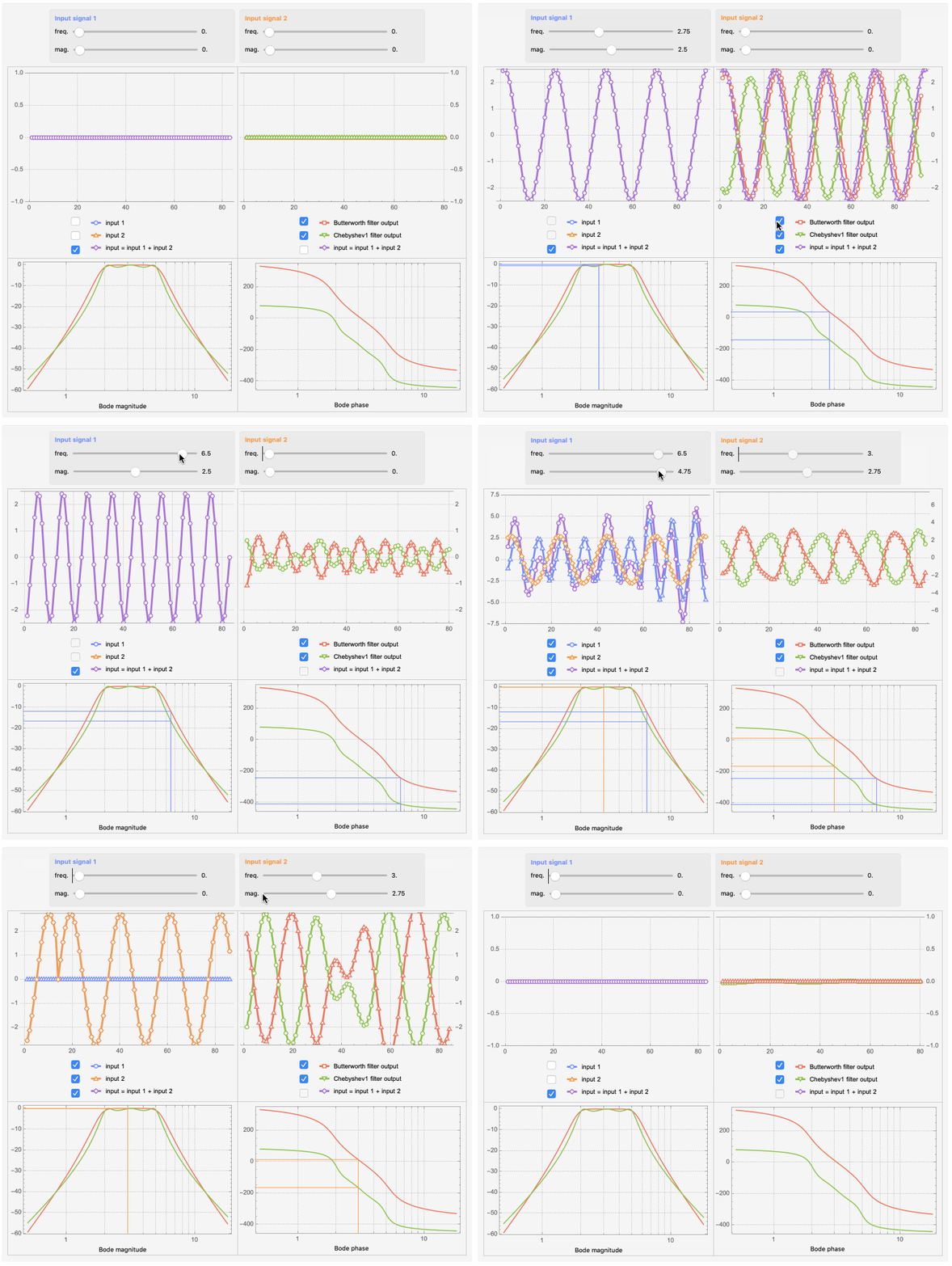
Logic Analysis
During runtime, the Arduino Nano board acts as a Digital Signal Processor (DSP) with the following logic:
- Input Acquisition: Receives input signals (either simulated or real signals from sensors).
- Digital Filtering: Feeds input values into the Difference Equation derived from Butterworth and Chebyshev filter calculations.
- Real-time Output: Sends the filtered values back out via the Serial Port for comparative plotting.
What's interesting is the juxtaposition of the theoretical frequency response and the measured response from the actual board. This clearly illustrates how hardware limitations, such as Sampling Rate and Bit Resolution, affect filter distortion.
This experiment is not merely about creating signal filters, but about demonstrating the efficiency of modern tools that enable engineers to quickly move beyond the complexities of low-level coding to system-level design and analysis.
For in-depth details and step-by-step instructions, please visit: cloud notebook