This project is about the interfacing of E30 sound sensor module with Arduino. This module can be interfaced with other microcontrollers and processors as well. I tried to show the demonstration of DRS Ultra-edge system and mechanism through the interfacing of this module.
Circuit Diagram:
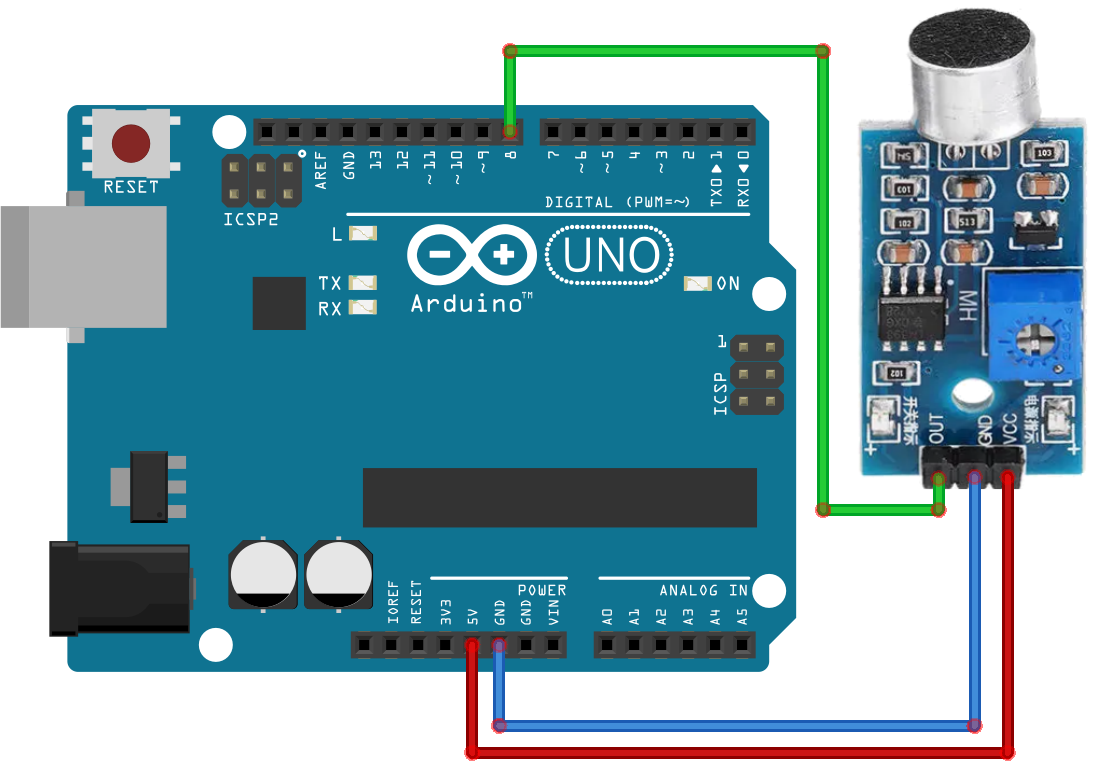
Code:
const int OUT_PIN = 8;  //The sensor's outpin is attached at Digital 8
const int SAMPLE_TIME = 10;
unsigned long millisCurrent;
unsigned long millisLast = 0;
unsigned long millisElapsed = 0;
int sampleBufferValue = 0;
void setup() {
 Serial.begin(9600); //Signifies sensor streaming 9600 bits of data/second
}
void loop() {
 millisCurrent = millis();
 millisElapsed = millisCurrent - millisLast;
 if (digitalRead(OUT_PIN) == LOW) {
   sampleBufferValue++;
 }
 if (millisElapsed > SAMPLE_TIME) {
   Serial.println(sampleBufferValue);
   sampleBufferValue = 0;
   millisLast = millisCurrent;
 }
}
E30 Sound Sensor Module Interfacing in my native Language (Bengali)
EXPANDED TECHNICAL DETAILS
Precision Acoustic Signal Analysis
This project explores the industrial application of the E30 sound sensor, providing high-speed noise monitoring and event triggering.
- Dynamic Thresholding Engine: The Arduino samples the analog intensity from the E30 Sound Module. Instead of a fixed value, the firmware calculates a "Rolling Average" to dynamically adjust the trigger sensitivity based on the room's background noise level.
- Latency-Critical Triggering: Uses a digital interrupt pin connected to the E30's "D0" output for near-instant reaction to sudden loud sounds (like a clap or a knock), bypassing the slower analog polling loop.
Visualization
- Acoustic Level Bar Graph: (Advanced version) Displays the real-time noise density as a vertical bar graph on an I2C OLED, mapping the analog values (0-1023) to a 64-pixel high visual dashboard.