This project is the definitive Masterclass in Fluid Dynamics and Real-Time Telemetry Engineering. FlowSense Alert is a high-performance Flow-Monitoring Workstation designed to provide precise, actionable data on liquid usage in critical environments. By leveraging Hall-Effect Pulse Frequency and a specialized **7-Segment Visual HUD**, this project empowers you to build a sophisticated safety asset that manages real-time flow rates and automated threshold interlocks with high-speed logical accuracy.
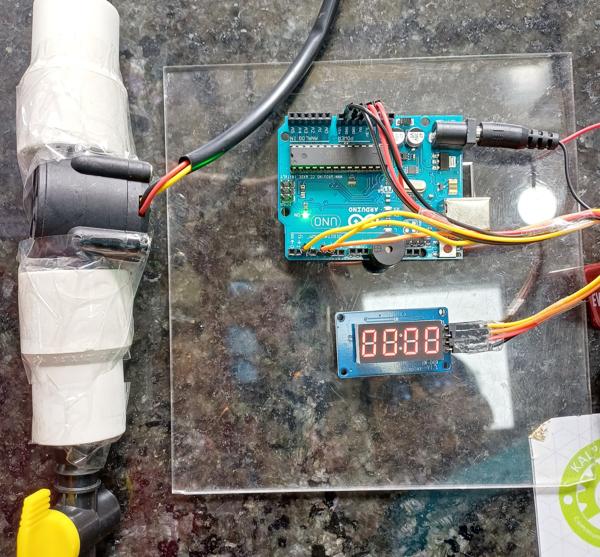
Fluid Infrastructure and Telemetry Architecture Overview
The FlowSense Framework functions through a specialized Detect-Calculate-Visualize lifecycle. The system is built on a high-reliability Temporal Pulse Model:
- Hall-Effect Sensory Shunt: The system utilize a specialized YF-S201 style sensor. As water flows through the pipe, an internal turbine spins, triggering a Hall-effect sensor to send 450 pulses per liter (Hz) to the Arduino. This data provides a High-Fidelity flow-profile.
- Frequency Analysis Logic: The software core. The Arduino firmware utilizes External Interrupts to count pulses in millisecond windows. It calculates the liters-per-minute (L/min) by applying a frequency-to-volume constant, ensuring sub-decimal accuracy even at variable pressures.
- 4-Digit Visual HUD: Through a specialized 7-Segment Multiplexor, the current flow rate is rendered as a clean numerical dashboard. This provides the operator with an Industrial-Grade readout that is visible from a distance without a PC connection.
Hardware Infrastructure & The Design Tier
- Arduino UNO R3 (The Command Brain): A chosen stable microcontroller that acts as the Pulse-to-Numerical Bridge, coordinating the timing between sensor frequency interrupts and the multiplexed display refresh cycles.
- Water Flow Actuator Hub: The "Perceptual Node." Specifically designed for 1-30L/min operation, it provides a stable logic signal that is resistant to fluid noise and mechanical friction.
- Aural Threshold Interlock: To prevent system overflow or pipe damage, a high-output buzzer acts as a Hardware Safety Alert. When the flow-rate exceeds a user-defined "Danger Zone," the system triggers a persistent audible alarm.
- Dual-Power Supply Matrix: The system is "Field-Ready," featuring a 12V adapter for permanent laboratory mounting and a 9V battery shunt for Portable Irrigation Testing or mobile field diagnostics.


Technological Logic and Execution Algorithms
The system reaches professional-grade reliability through several Firmware Orchestration Strategies:
- Interrupt-Driven Pulse Shunts: To ensure that no data is lost at high flow rates, the firmware utilizes Hardware Port Interrupts. This allows the system to background-count pulses while the main loop handles the visual HUD update and threshold logic.
- Liters-to-Gallon Mapping: The code includes a Mathematical Conversion Rail, allowing the user to toggle between metric and imperial units by simply changing a software constant in the setup block.
- Real-Time Limit Comparison: The "Safety Core." The firmware compares the current
flowRatevariable against amaxThresholdevery cycle. If the condition is met, it modulates the PWM frequency of the buzzer to create a distinctive "Alert Pulse." - Hardware Scalability: Validated for water, this modular architecture is "Multi-Fluid Ready," with the option to calibrate different pulse-constants for oils or chemical solutions in industrial dosing applications.
Why This Project is Important
Mastering Fluid Telemetry and Frequency-Based Sensing is an essential skill for Environmental Engineers and Industrial Automation Specialists. It teaches you how to design a "Physical-to-Digital" system that monitors real-world movements and enforces safety bounds—a critical skill for designing smart irrigation, water treatment plants, and home leak detection systems. Beyond simple meters, these same principles are used in Automated Beverage Dispensers, Hydro-Electric Power Monitors, and Medical Dialysis Machines. Building this project proves you can engineer a professional-grade monitoring asset that prioritizes sensor precision, visual clarity, and automated safety response.
Technical Engineering Tip: For the most accurate readings, ensure the flow sensor is mounted Horizontally. For the firmware, use the volatile keyword for your pulse-counter variable to ensure the Arduino's main loop and interrupt-service-routine (ISR) share the data correctly without Memory Access Corruption.