Artificial Life: Conway's Game of Life
Conway's Game of Life is not a game you "play"—it's a zero-player simulation. Based on the work of mathematician John Conway, it demonstrates how complex, organic-looking behavior can emerge from a few simple logical rules.
The Rules of Life
In this simulation, a grid of pixels ("cells") evolves over generations:
- Survival: A live cell with 2 or 3 neighbors survives.
- Death: A live cell with too few or too many neighbors dies.
- Birth: A dead cell with exactly 3 neighbors becomes alive.
Hardware Setup
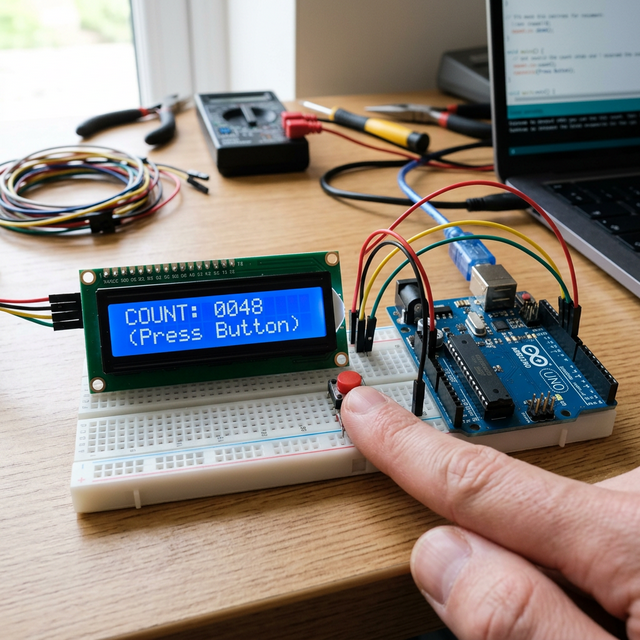
While you can run this on a 16x2 LCD, it looks best on a 0.96" I2C OLED display. The higher resolution (128x64) allows you to see interesting "creatures" like Gliders, Pulsars, and Gosper Glider Guns as they move across the screen.
- Arduino Uno/Nano: To process the logic.
- 0.96" OLED Display: To visualize the grid.
- Push Button: To randomize the board and start a new "simulation."
Coding Challenge
This project is a great exercise in Memory Management. An Arduino Nano only has 2KB of SRAM. To store a 64x64 grid of cells, you need to use bit-manipulation (storing 8 cells in a single byte) to fit the whole "universe" into the Arduino's limited memory.