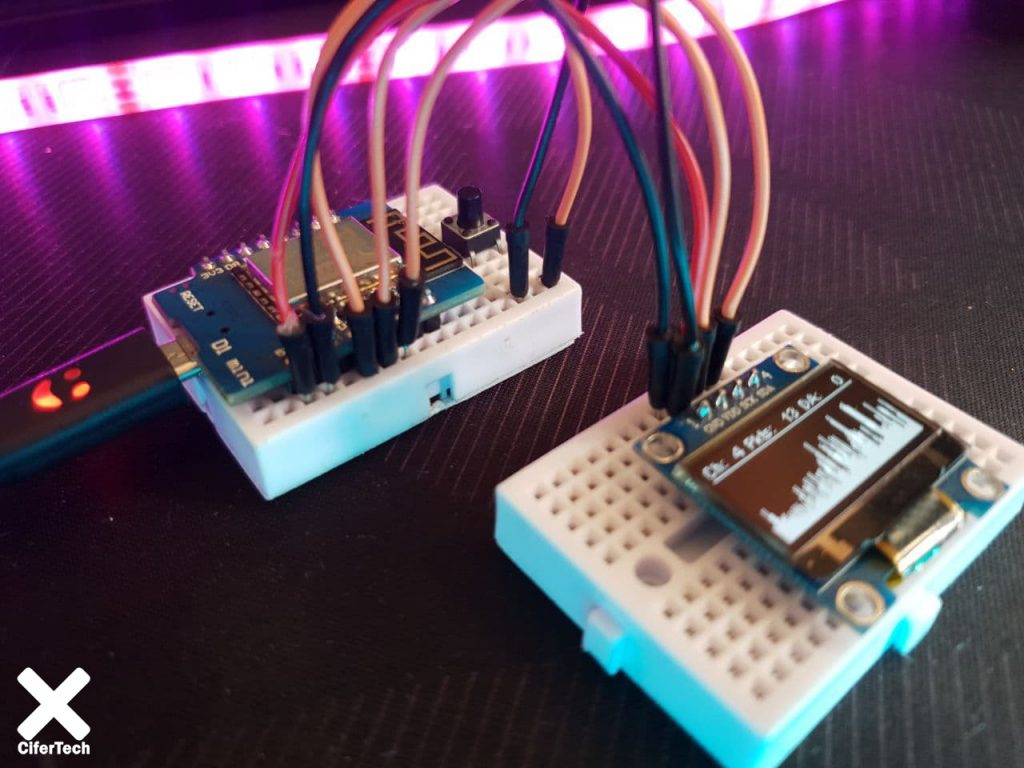
is there traffic on your network when you are not using it? Or what information does this traffic have, the answer to these needs will all be met with an interesting and practical device called Packet Monitor. It is a computer program or hardware, which can record the traffic that passes through the computer network or part of the network. When data flows through the network. Analyzers can store each packet and decrypt raw packet data if needed. In this project, we will build a PacketMonitor device with ESP8266 board. We will receive the traffic in each channel and then display it graphically in graphs using the OLED display. Visit CiferTech for more tutorials, and be sure to follow my Instagram page to support me.
Cybersecurity Hardware: The Wi-Fi Analyzer Box
Disclaimer: This project is strictly for educational purposes and diagnosing your own personal home network to find the best uncluttered Wi-Fi channel.
The Wi-Fi Analyzer Box is a powerful cybersecurity demonstration using the ESP8266 chip. Because the ESP8266 is inherently a networking chip, its firmware can be programmed into "Promiscuous Mode" to "listen" to all the invisible Wi-Fi packets flying through the air around you.
How PacketMonitor Works?!
In this project, the traffic values in the channel specified from 1 to 14 are received with the help of ESP8266 WiFi board and Wemos boot board, and in the Oled display, which is driven by the i2c interface, graphically in the form of incoming traffic at any time. is shown. We will also be notified if there is a malfunction or deauth attack on the channel in question. We will also be able to change the channel number being analyzed using the key attached to pin D3 on the Wemos board.
Promiscuous Mode Packet Sniffing
Normally, an ESP8266 connects to a router and ignores all signals not aimed at it.
- The Hack: In this project, the code breaks that rule (
wifi_set_opmode(STATION_MODE)andwifi_promiscuous_enable(1)). The ESP acts like a massive radio antenna, sweeping through channels 1 through 11. - Packet Counting: It rapidly counts every Beacon Frame and Data Packet it hears in the air, creating a massive integer count.
- The Graphical Interface: The Arduino pushes this data to an I2C OLED Screen. It draws an animated histogram, showing a massive spike on Channel 6, proving that everyone in your apartment complex is using the exact same channel and causing lagging internet!
Essential Assembly
- ESP8266 NodeMCU or Wemos D1 Mini: The raw processing power is required for sniffing.
- 1.3" or 0.96" OLED Display: To visualize the histogram charts.
- LiPo Battery & TP4056 Charger: To make it a portable, handheld hacking tool.
- Rotary Encoder: To cycle through different analyzer modes on the menu.
This builds foundational knowledge for Network Engineering and understanding how 802.11 b/g/n packets travel through walls.