Project Description:
This project uses an IP camera to roughly classify a room as “messy” or “clean” based on the camera feed. When the room is detected as messy, a relay is triggered to make a smart dimming film turn opaque. When the room is detected as clean, the film becomes transparent. This project relies on an IP camera. Please make sure to properly configure your network and take appropriate security precautions according to your own environment.
Marina Fujiwara, Mudazukuri
Have you ever wished you could just "turn off" the sight of a messy room? The Invisible Mess Glasses make this dream a reality—or at least a very tech-savvy illusion. This project uses a combination of computer vision and smart materials to react to the state of your environment in real-time.
How It Works
The system relies on an IP Camera positioned to overlook your room. A Python script running on a host computer (or a powerful enough SBC) classifies the room as "messy" or "clean" based on deep learning models.
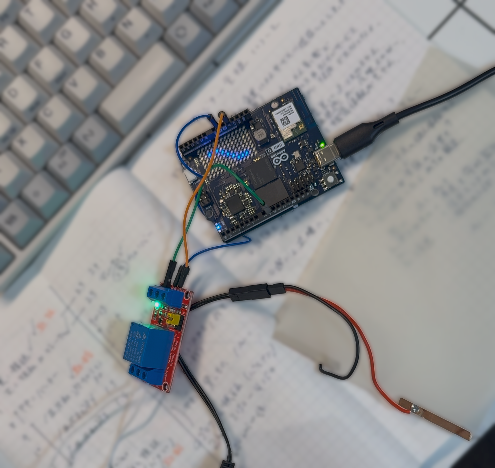
When a "messy" state is detected, the Arduino receives a command to trigger a Relay Module, which in turn activates a Smart Dimming Film applied to the lenses of the glasses. The film transitions from transparent to opaque instantly, effectively "hiding" the mess from your sight.
Electronics and Hardware
The heart of the project is the Arduino UNO Q, which bridges the gap between the high-level AI classification and the physical hardware control.
Components Required:
- Arduino UNO Q: Handles logic and relay control.
- Relay Module: Acts as the switch for the high-frequency smart film.
- Smart Dimming Film: Applied to custom 3D-printed glass frames.
- IP Camera / Webcam: Captures the room imagery for AI analysis.
- 5V/12V Power Supply: Depending on the specific smart film requirements.
Software Logic
The software is split into two parts:
- Python Backend: Uses OpenCV and a classification model to monitor the room.
- Arduino Sketch: Listens for serial commands to toggle the relay.
This project is a perfect demonstration of how Computer Vision and Embedded Systems can work together to create interactive, albeit humorous, wearables.