In this project information from multiple ESP8266 boards via the ESP-NOW communication protocol with a one-to-Many scenario. several ESP boards send the data we want to one board. There is no such thing as a transmitter or receiver in ESP-NOW documents. Each ESP8266 board can be a transmitter or a receiver. However, we will use these terms to describe the status of each board in the project. Visit CiferTech for more tutorials, and be sure to follow my Instagram page to support me.
ESP-Now protocol
ESP-NOW is a wireless communication protocol developed by Espressif and capable of packet transmission. This protocol enables multiple devices to easily communicate with each other and transfer information optimally between each other. This protocol is similar to the 2.4 GHz wireless connection, often used in wireless mice. Therefore, it is necessary to pair the devices before communicating. This means that the connection is stable after the devices are paired with each other. In other words, if one of your ESPs suddenly shuts down or resets, the connection is established automatically when you restart.
Project Description
In this project, we used two ESP8266 boards, version 01, which are assembled in a personalized PCB, in one of the boards, or in other words, our nodes, an OLED display is installed to display the received items, and in the other board. A DHT11 sensor is installed to measure temperature and humidity. This way we will be able to collect more data by increasing the nodes.
PCB
In order to establish connections in this project, we use a PCB designed with the help of Altium Designer. This circuit includes the connections required for OLE modules and DHT11 sensor, as well as the power input and serial output to program the board. There is also a relay in this circuit that will not work due to a bug in this version of the PCB.
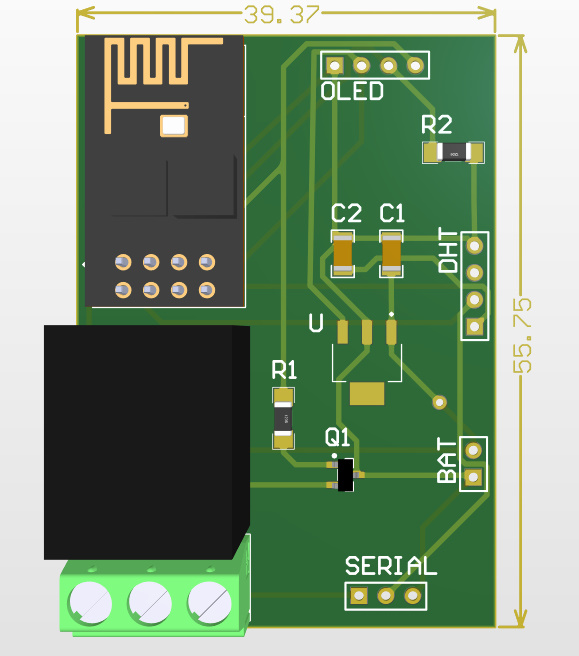
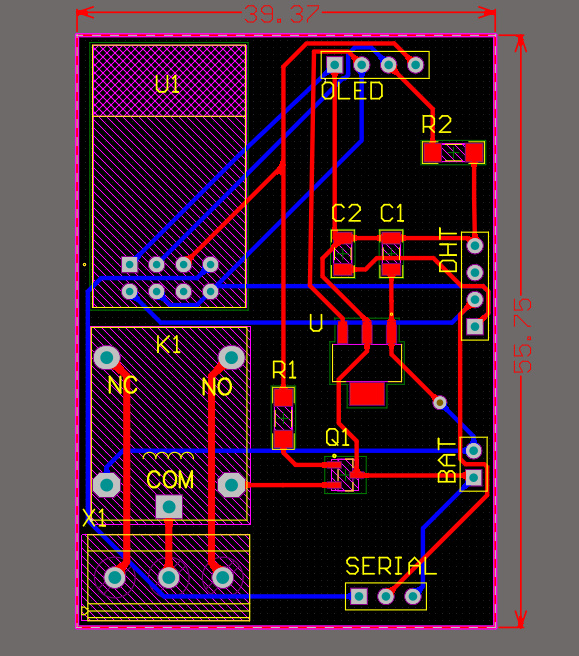
EXPANDED TECHNICAL DETAILS
High-Efficiency Mesh Data Telemetry
This project demonstrates the use of ESP-NOW, a connectionless WiFi protocol, to create a low-latency, long-range sensor network without requiring a router.
- Direct MAC-Address Pairing: The "Node" ESP32 communicates directly with a "Master" gateway by targeting its specific MAC address. This bypasses the time-consuming WiFi handshake (DHCP/Gateway) process, allowing for instant data transmission.
- Asymmetric Deep-Sleep Cycle: The Node stays in a deep-sleep state, waking only for 100ms to sample its sensors and push a single ESP-NOW packet before returning to sleep, ensuring months of battery life.
Performance
- Zero-Handshake Efficiency: Achieves a "Wake-to-Transmit" time of less than 200ms, making it ideal for high-speed industrial triggers or agricultural monitoring.