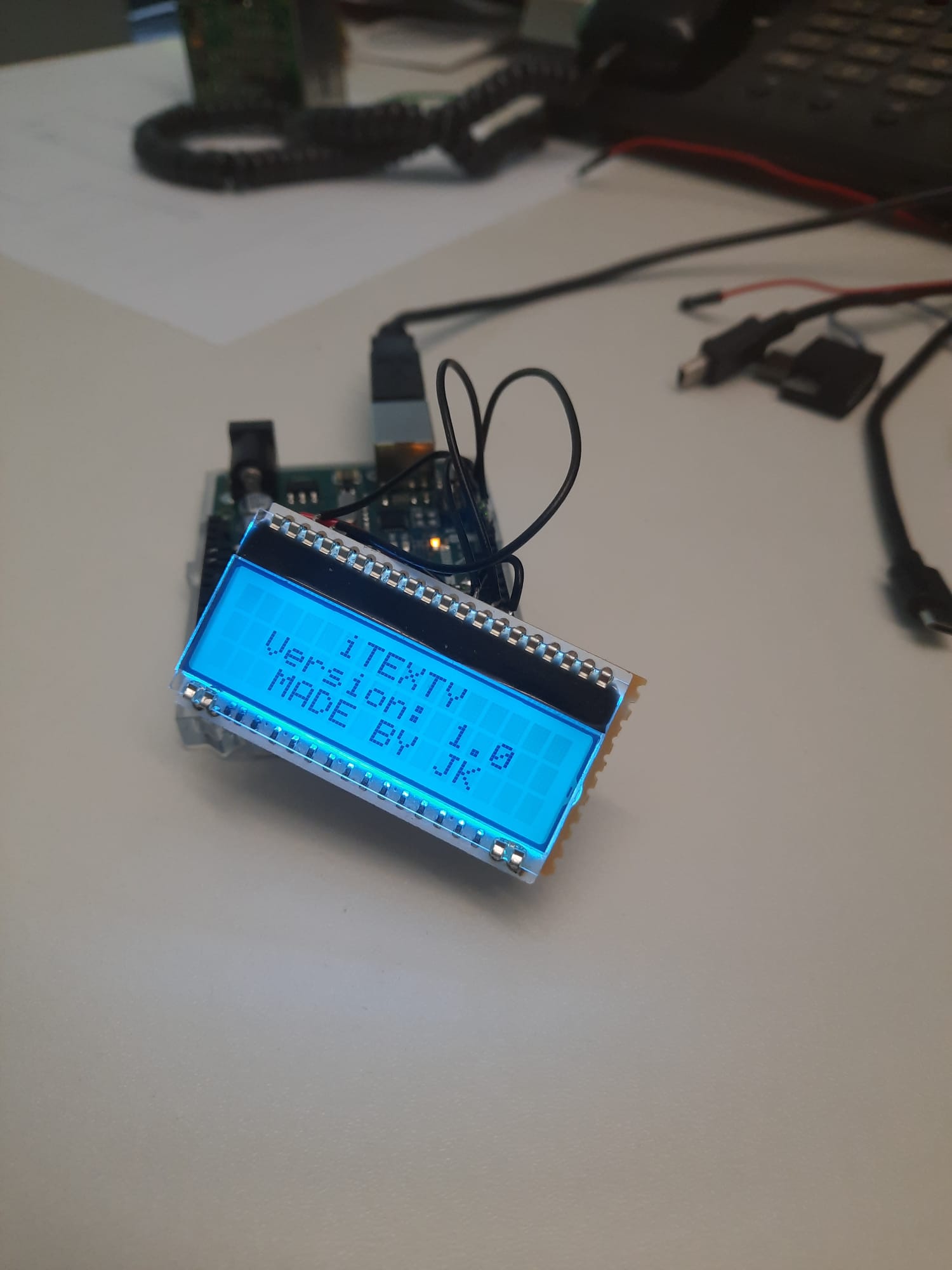
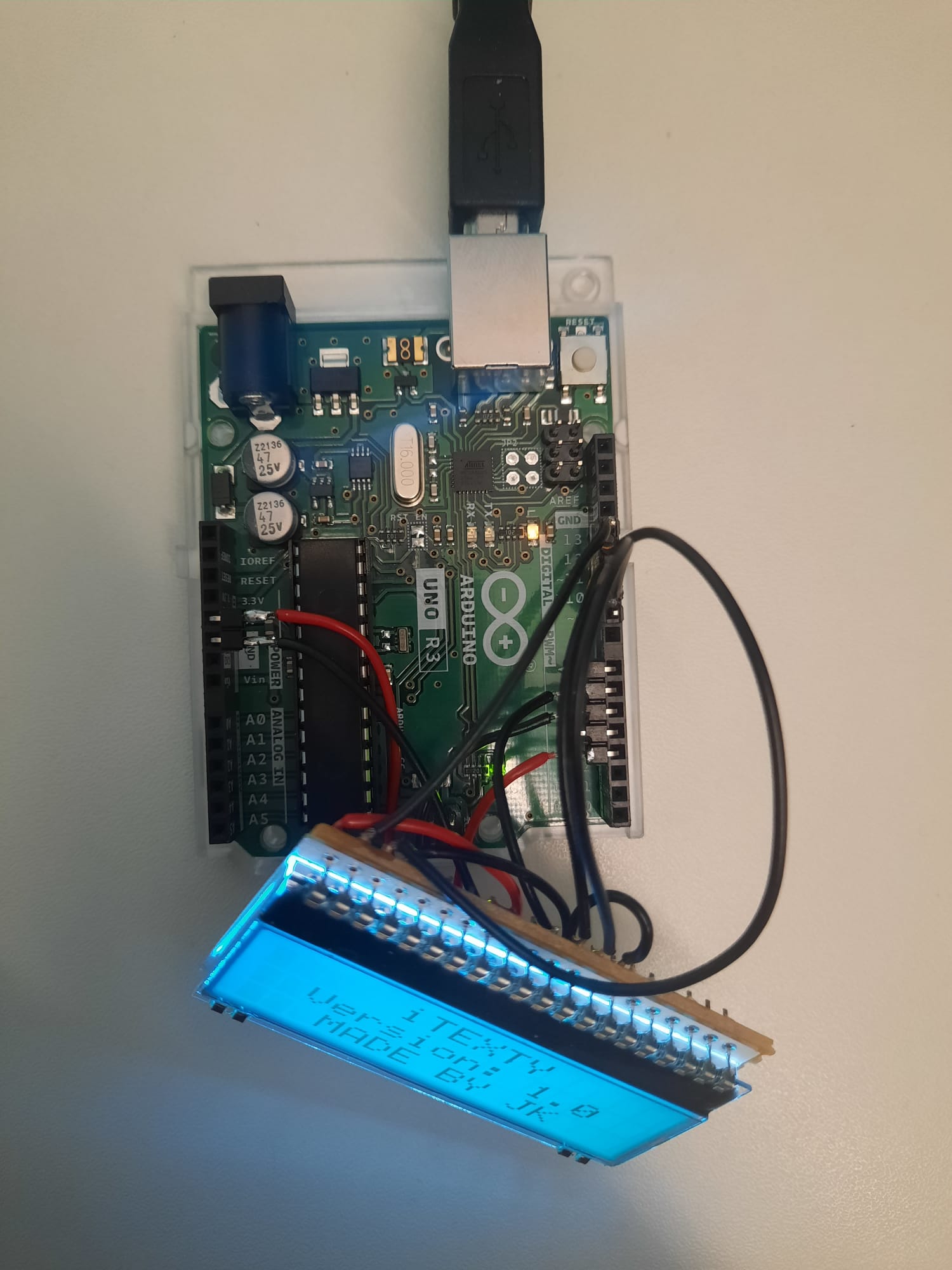
The name of the project is iTEXTY. The goal of this project was to control an LCD display via the serial interface, for this I used a DOGM163 lcd display with an RGB backlight that was connected serial to an Arduino Uno. The libraries DogLCD.h and EEPROM.h were used. I wish you a lot of fun integrating and copy my project into yours.
Project Overview
"iTEXTY" is a rigorous implementation of Asynchronous UART-Telemetry Forensics and LCD-Rasterization Analytics. Designed to decouple processing-heavy string manipulation from primary microcontrollers, this project transforms an Arduino Uno + DOGM163 LCD into a dedicated, autonomous serial-terminal. The project explores the sophisticated mapping of incoming Universal Asynchronous Receiver-Transmitter (UART) character-streams into deterministic pixel-matrix activations. The build emphasizes high-speed serial-bus orchestration, SPI/I2C translation heuristics, and non-volatile EEPROM memory-diagnostics.
Technical Deep-Dive
- UART-Forensics & Data-Deserialization:
- Serial-String Interconnect Hub: Utilizing the Arduino's hardware UART (RX/TX). Forensics involve the measurement of the "Baud-Rate Serialization Latency"; the system continuously polls the RX-buffer
Serial.available()constraint. The diagnostics focus on "ASCII-String Parsing Analytics," buffering incoming characters until a termination-null or carriage-return is encountered, absolute for preventing buffer-overruns during high-frequency telemetry-bursts from external systems. - DogLcd.h Rasterization Engine: Mapping the deserialized strings to the physical DOGM163 16x3 character-matrix. Forensics include the verification of "Display-Update Frequency"; the library translates standard C++
print()calls into the specific instruction-set required by the ST7036 LCD controller.
- Serial-String Interconnect Hub: Utilizing the Arduino's hardware UART (RX/TX). Forensics involve the measurement of the "Baud-Rate Serialization Latency"; the system continuously polls the RX-buffer
- RGB-Backlight & Logic-Bus Aesthetics:
- PWM Chromatic-Orchestration: Driving the specific R, G, and B anodes of the DOGM163 display. Forensics focus on "Duty-Cycle Color-Mixing," utilizing 8-bit
analogWrite()commands to generate custom aesthetic-alerts (e.g., flashing red for error-telemetry, solid green for nominal-operation). - EEPROM State-Persistence Diagnostics: Storing the current RGB-values and display-configurations in the ATmega328P's non-volatile memory. The diagnostics focus on "Write-Cycle Mitigation Analytics," executing EEPROM
update()logic rather thanwrite()to preserve the silicon's 100,000-cycle limit, ensuring the display boots up in the exact state it was powered down in.
- PWM Chromatic-Orchestration: Driving the specific R, G, and B anodes of the DOGM163 display. Forensics focus on "Duty-Cycle Color-Mixing," utilizing 8-bit
Engineering & Implementation
- Hardware-Topology & Substrate Forensics:
- Voltage-Translation Analytics: The DOGM series often operates natively at 3.3V. Forensics include the measurement of "Logic-Level Compatibility," ensuring the Uno's 5V TTL logic does not over-stress the LCD controller's input-pins, requiring meticulous series-current limiting or active level-shifting components.
- SPI-Interconnect Optimization: While communicating outward via UART, the Uno likely drives the DOGM163 locally via SPI. Forensics focus on "Clock-Phase/Polarity Optimization," guaranteeing high-speed pixel refreshes without corrupting the character-RAM (CGRAM).
- System-Logic & Workflow Heuristics:
- The implementation demonstrates a "Decentralized-Display Paradigm," proving that offloading HMI (Human-Machine Interface) tasks to a dedicated UART-slave node frees up crucial cycle-time on a primary robotics or automation controller. Forensics include the measurement of the "Byte-to-Pixel Propagational Latency," absolute for real-time diagnostic debugging.
Conclusion
iTEXTY represents the pinnacle of Asynchronous Serial-Display Diagnostics. By mastering UART-Protocol Forensics and EEPROM-Persistence Heuristics, kudero has delivered a robust, professional-grade visual-framework that provides absolute telemetry-clarity through sophisticated serial-raster diagnostics.
Telemetry Persistence: Mastering visual diagnostic-streams through UART forensics.