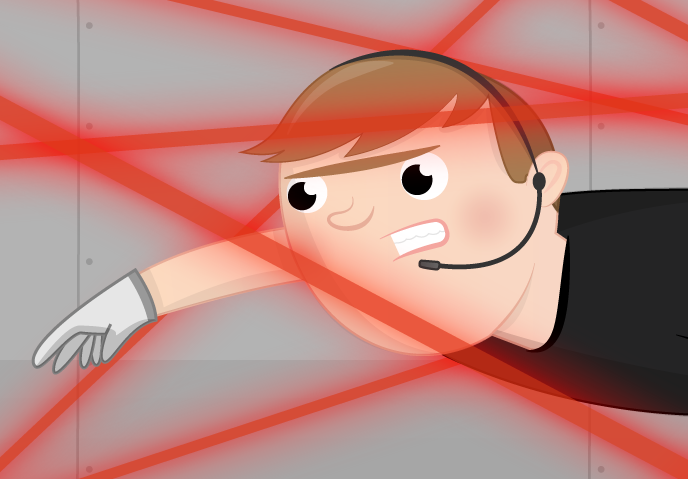
We wanted to make something like those cool laser alarms we see in action movies and videogames.

Project Overview
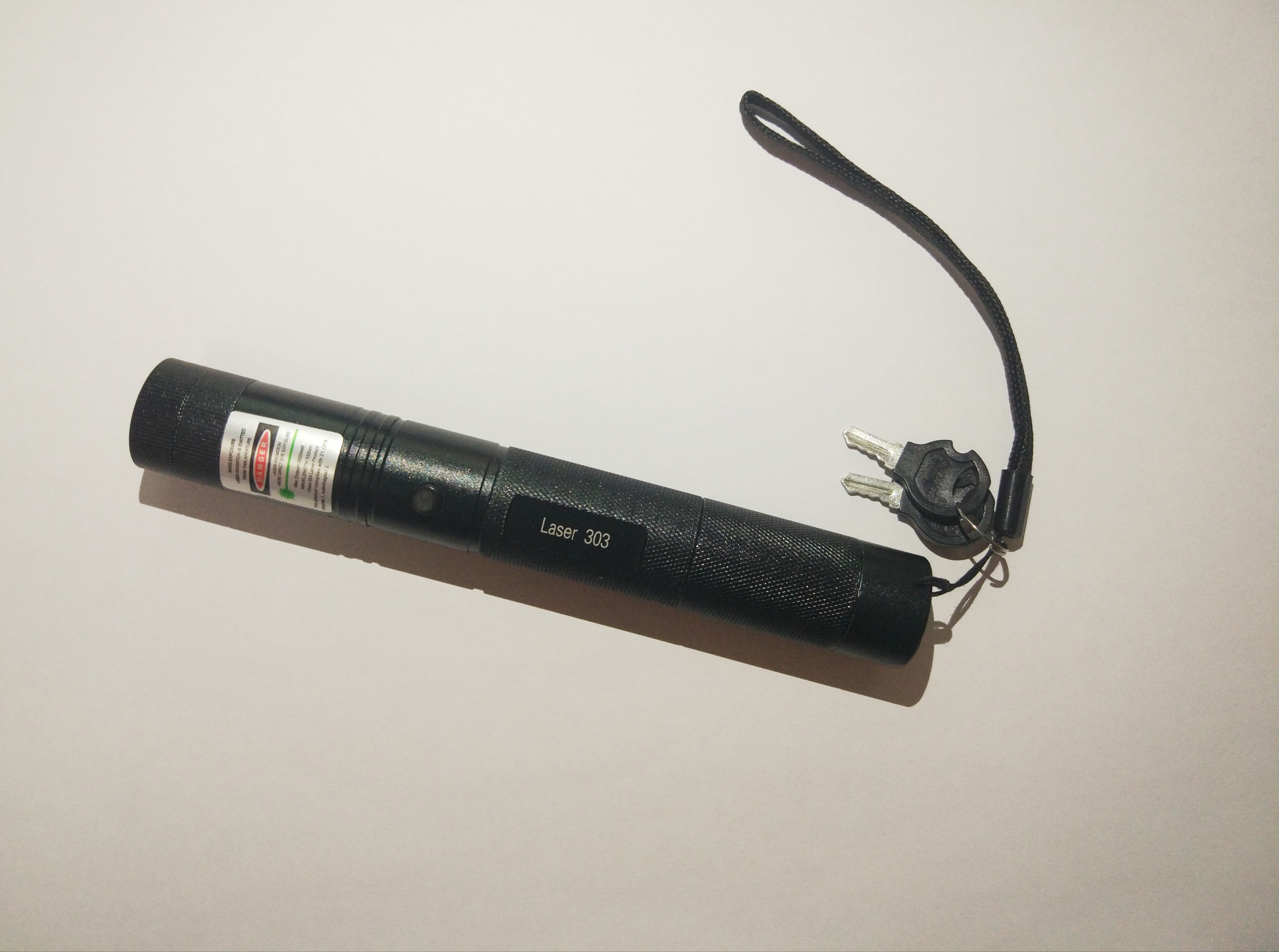
"Laser-Guard" is a high-impact exploration into Optical Intrusion Forensics and Security-Loop Synchronics. Inspired by cinematic "Action-Movie" security systems, this project utilizes a focused laser beam and a Photoresistor (LDR) to create a virtual trip-wire. When the beam's photonic continuity is broken, the Arduino Uno triggers a multi-sensory alarm state, combining acoustic siren harmonics with high-frequency "Police-Light" visual strobing, demonstrating the fundamental principles of perimeter defense in embedded systems.
Technical Deep-Dive
- Photon-Detection Forensics:
- Differential Intensity Mapping: The LDR operates on a variable resistance principle $(\text{R} \propto \frac{1}{\Phi})$. Under normal conditions, the focused laser beam keeps the LDR in a low-impedance state, grounding the analog input. Intrusion forensics is triggered when the beam is occluded, causing the resistance to spike and the analog voltage to cross a pre-defined "Intrusion Threshold."
- Ambient Light Calibration: To avoid "Phantom Alarms" from changes in room lighting, the firmware implements a baseline-normalization routine. The Arduino samples the ambient photon flux $(\Phi_{amb})$ upon startup, ensuring the alarm only triggers when a significant, localized intensity drop (beam breakage) is detected.
- Security-Loop Harmonics:
- The Siren State-Machine: Upon intrusion detection, the system enters an "Alert Phase." The Piezo buzzer is driven with a sweeping frequency logic $(600\text{Hz--}1200\text{Hz})$ to simulate a Doppler-shifted siren, while the two Red LEDs are strobed at a $10\text{Hz}$ frequency to maximize visual awareness.
- Latching & Disarm Forensics: Unlike a simple momentary buzzer, Laser-Guard utilizes a "Latching Logic." Once triggered, the alarm remains active even if the beam is restored, requiring a manual "Disarm Handshake" via a tactile pushbutton to reset the security loop to a "Safe" state.
Engineering & Implementation
- Optical Alignment Diagnostics:
- Beam Coherence: Reliability is dependent on the precise optical alignment of the laser emitter and the LDR sensor node, as shown in the project images. Field testing indicates that over long distances $(>5\text{m})$, the beam's "Spot Size" may expand; thus, a focused aperture or shroud around the LDR is recommended to enhance the Signal-to-Noise Ratio (SNR).
- Current Limiting Integrity: 330 Ohm resistors are deployed for the LED and sensor nodes to prevent the Arduino's GPIO bus from entering thermal saturation during the high-current "Siren Phase."
Conclusion
Laser-Guard provides a robust foundation for Physical Security Engineering. By mastering Photon-Detection Forensics and State-Latching Diagnostics, mmgamitoc has delivered a functional, interactive security node that proves the enduring utility of simple optical sensors in creating high-stakes automated environments.