This project is the ultimate fusion of Aesthetic Art and Optical Engineering. The Laser Harp is a professional-grade Expressive Controller that replaces physical strings with invisible beams of light. By breaking a laser beam with your hand, you trigger high-fidelity MIDI (Musical Instrument Digital Interface) commands, allowing you to "Play the Air" and control any virtual instrument in your favorite DAW.
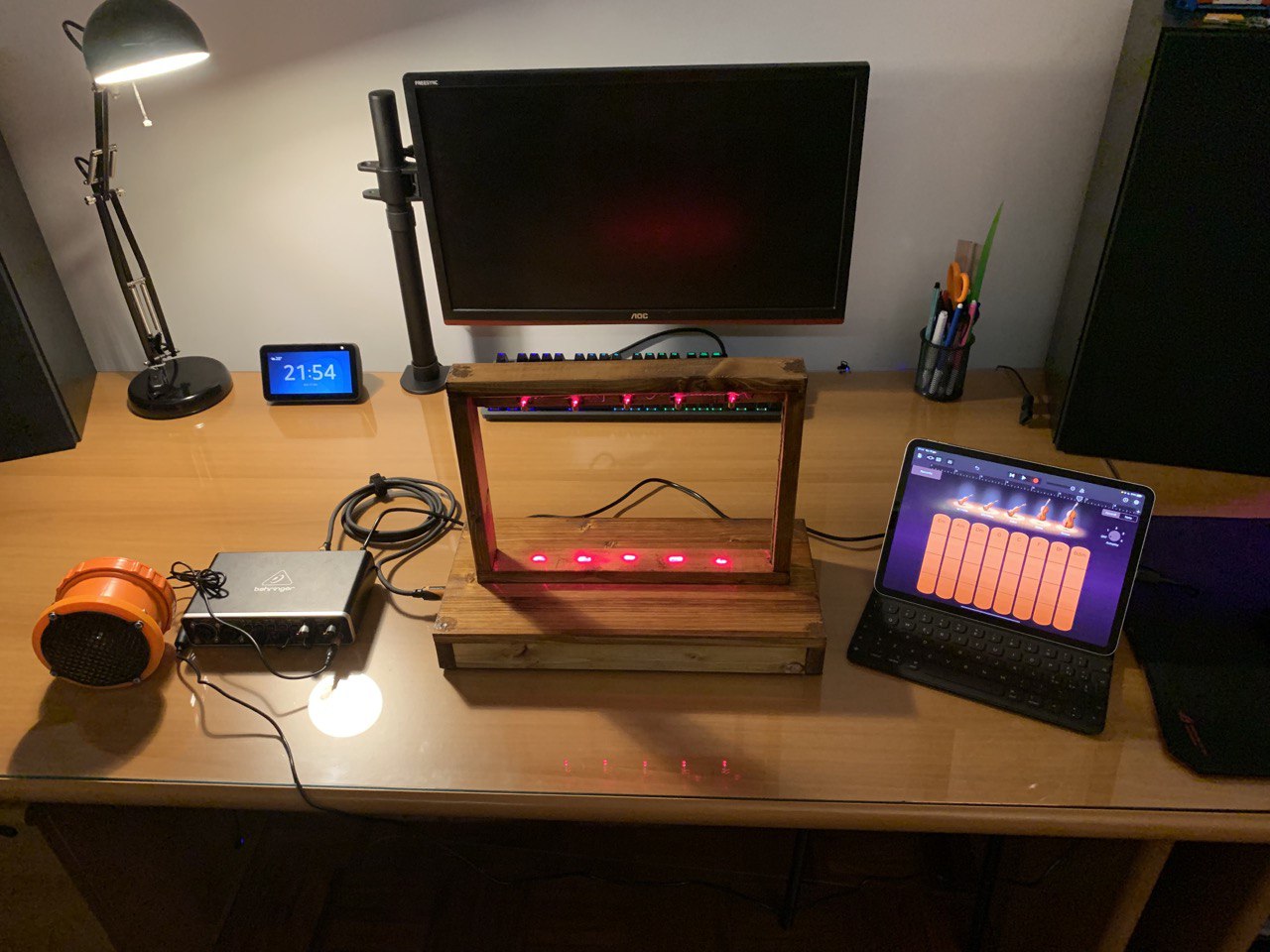
Optical MIDI Control Architecture Overview
The Laser Harp functions through a specialized Luminous-Interrupt-to-Note lifecycle. Instead of the Arduino generating sound directly (which is limited by its 8-bit memory), it acts as a High-Frequency MIDI Encoder. By monitoring the resistance of a Photoresistor (LDR) placed directly in the path of a focused laser diode, the Arduino can detect the microsecond-level moment the beam is "Broken." This event is instantly translated into a 3-byte MIDI "Note On" message and streamed over a dedicated 5-pin DIN connector to a sound card.
Hardware Infrastructure & The Musical Tier
- Arduino Uno R3: The "Note Processor." It handles the analog-to-digital (ADC) conversion of the LDR values while maintaining the strict 31,250 baud rate required by the global MIDI protocol standard.
- Visible Red Laser Diode (5V): The "String Generator." It provides a concentrated point of light that creates a high-contrast shadow on the LDR, ensuring the system can distinguish between ambient room light and a deliberate "Pluck."
- Photoresistor (LDR) & 10k Divider: The "Optical Picker." Configured as a voltage divider, it turns the change in light into a measurable voltage change (0V to 5V), which the Arduino logic treats as the trigger for a specific musical note.
- MIDI Connector (5-Pin DIN): The "Standardized Link." This allows the Laser Harp to be truly industrial; it can plug into professional synthesizers, sound cards, or keyboards, making it more than just a toy.
- External DAW (Garage Band): The "Sound Engine." By using high-end software on an iPad or PC, the Laser Harp gains access to world-class piano, violin, or synthesizer sounds, resulting in a studio-quality performance.
Technological Logic and The MIDI Protocol
The system reaches high responsiveness through several Logic-Driven Mapping Strategies:
- The Threshold Calibration: The code includes an auto-calibration phase at boot-up. It measures the ambient light level and sets a "Trigger Floor" slightly lower than the laser's intensity to prevent false triggers.
- Binary Note Logic: Instead of complex calculations, the system uses a simple boolean:
if (ldrValue < threshold) { sendMidiNoteOn(60); }. This ensures zero-latency playback. - Velocity Emulation: While this version is "On/Off," the project explores how the speed of the hand movement through the beam could be mapped to MIDI Velocity, allowing for "Loud" or "Soft" notes based on performance intensity.
- Multi-Beam Expansion: The project explains how to scale from a single beam to a full 8-note octave by adding additional LDRs and lasers to the Arduino’s multiple analog ports.
Why This Project is Important
Mastering Optical Sensors and Universal MIDI Communication is an essential skill for Sound Design, HCI (Human-Computer Interaction), and New Media Art. It teaches you how to bridge the physical world with the digital arts using standardized industry protocols. Beyond musical harps, these same principles are used in Industrial Safety Light Curtains, Optical Encoders for CNC Machines, and Interactive Public Art Installations. Building this harp proves you can handle high-precision timing and high-fidelity output for professional artistic expression.