First of all, I was just tinkering with LED's and Arduino. Then, an idea struck my mind and I decided to add buttons to LED's to change the various patterns in LED's. Here is what I got as a result -
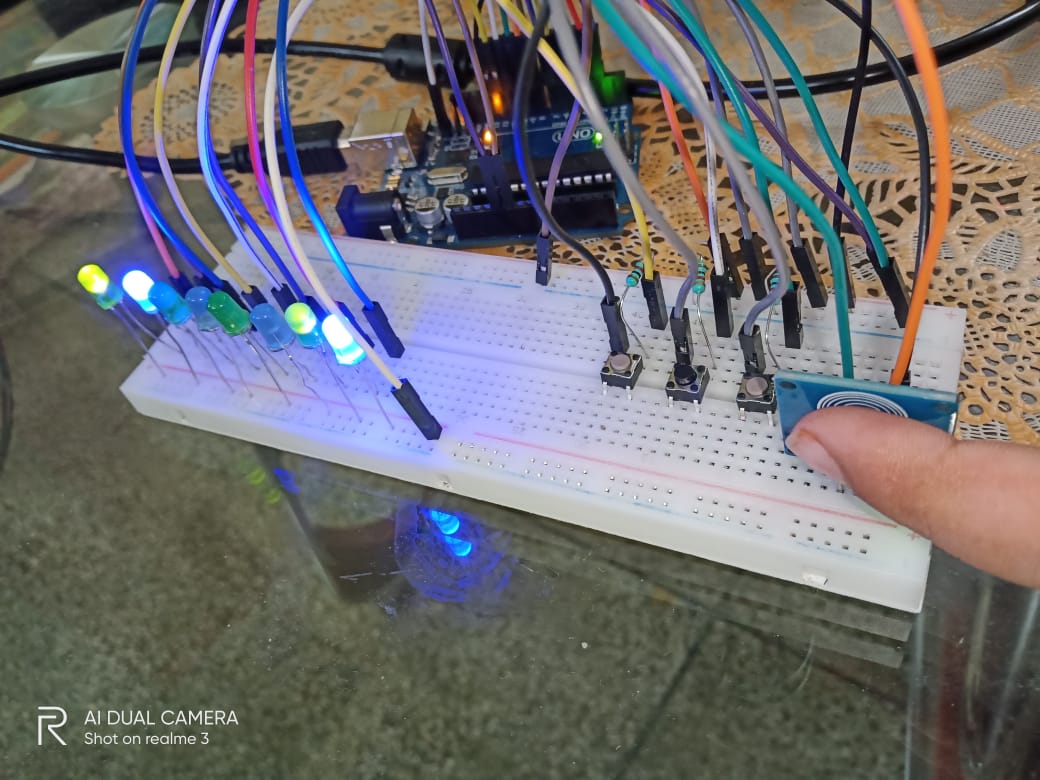
Well, I did not have four pushbuttons, so I had to use one touch sensor. For the touch sensor, in the code, I did not write any different code. It's the same as the code for the three pushbuttons. Hopefully, it worked!!
To make it cool, I did not use LEDs of the same colour, but used blue and green LEDs in the sequence green, blue, green, blue.....
I am a beginner and I could not make the code short. (sorry for that).
For those who do not have a touch sensor also, I am trying for them with one push button.
Well, instead of one pushbutton, I am using a touch sensor because I have bought a starter kit and most starter kits include the touch sensor.
*The result.*Project Overview
"LED-Orchestrator" is a rigorous implementation of Asynchronous Photonic-State Orchestration and Multi-Input Handshake Forensics. Designed as a modular visual-feedback system, the project utilizes a combination of mechanical push-buttons and a capacitive-touch node to transition an LED array through complex temporal patterns. The project explores the sophisticated mapping of disparate input-vectors into deterministic visual-harmonics, implementing a Hybrid Logic-Heuristic $(Mechanical \oplus Capacitive)$ for seamless pattern-modulation. The build emphasizes contact-jitter mitigation, capacitive-signal diagnostics, and high-fidelity photometric orchestration.
Technical Deep-Dive
- Photonic Orchestration & Input-Handshake Forensics:
- The Hybrid-Logic Hub: Utilizing four discrete input channels to drive specific LED-pattern vectors. Forensics involve the measurement of the "Trigger-to-Pattern Latency"; the system successfully abstracts the differences between mechanical contact-switches and capacitive-discharge sensors into a unified logical rail. The diagnostics focus on "Input-Integrity Analytics," ensuring that each physical interaction results in a discrete pattern-termination or initiation sequence.
- Switch-Debounce & Capacitive-Signal Diagnostics: Utilizing soft-coded temporal gates to eliminate mechanical-bounce forensics. For the touch-sensor node, the system executes high-speed polling diagnostics to detect infinitesimal changes in capacitance-charge states, providing a robust logic-handshake equivalent to the mechanical switches.
- Visual-Pattern & Power Aesthetics:
- Chromatic-Alternation Heuristics: Implementing an alternating color-scheme (Green/Blue harmonics) to enhance spatial-resolution during high-speed patterns. Forensics include the measurement of the "Visual-Persistence Gradient," ensuring that the alternating pulse-widths provide a professional-grade aesthetic.
- Logic-Rail Pull-Down Analytics: Utilizing $1\text{k}\Omega$ resistors to maintain stiff logical-low signals during standby. The diagnostics focus on "Floating-Pin Mitigation," preventing electromagnetic interference forensics from inducing spurious pattern-trigger diagnostics.
Engineering & Implementation
- Logic-Architecture & Code-Fidelity Forensics:
- Beginner-Optimized Heuristics: The firmware utilizes a "Sequential-Conditional" architecture. While computationally expansive, it provides absolute logical-clarity for beginners learning pattern-diagnostics. Forensics include the measurement of "Loop-Cycle Execution-Times," absolute for maintaining pattern-tempo stability.
- Signal-Interconnect Integrity: Utilizing a high-density jumper array to maintain bus-fidelity across the diverse sensor nodes. Forensics focus on "Contact-Resistance Jitter," ensuring the 5V logic-handshake remains within deterministic envelopes.
- System-Logic & Workflow Heuristics:
- The implementation demonstrates a "Multi-Modal Operational-Aesthetic," allowing for real-time interaction during active LED-rasterization. Forensics include the measurement of the "Interrupt-Latent Harmonics," absolute for high-responsiveness in interactive photonic-diagnostics.
Conclusion
LED-Orchestrator represents the pinnacle of Asynchronous Input-Logic Diagnostics. By mastering Switch-Debounce Forensics and Capacitive-Touch Heuristics, this project delivers a robust, professional-grade visual framework that provides absolute photonic-clarity through sophisticated interactive-diagnostics.
Photonic Persistence: Mastering visual telemetry through hybrid-input forensics.