The World Health Organization, WHO, has advised people to stay away from crowded places to protect themselves from the spread of Coronavirus disease. Even though people practice social distancing, it may not be effective when they are present in crowded places. I came up with this idea after I read the WHO guidelines about preventing the spread of COVID-19.
Aim/ Objective
This project is an automatic, cheap and effective way of limiting the crowd in public places - such as shopping malls, supermarkets, offices - and public transport vehicles, such as buses and trains.
Using a human to limit the number of people in a particular place would not be as effective as using an automatic system due to the lack of staff members in some areas.This prototype can be used in real-life situations by replacing the servo motor with a solid state relay module.
The solid state relay module will control the motor operating the automatic sliding doors in buildings and vehicles. There will be a slight change in code when replacing the servo motor.
How it works
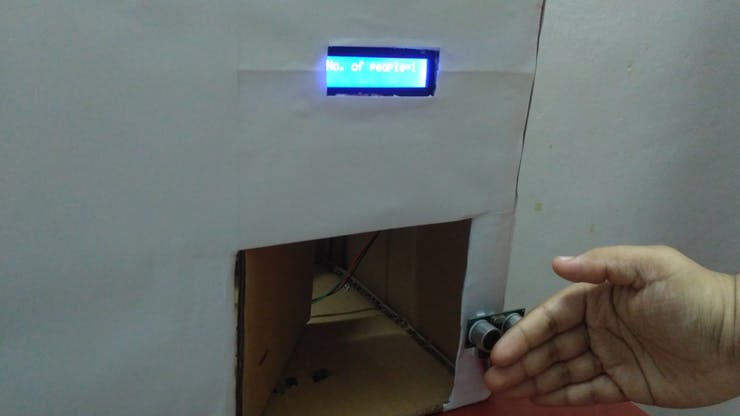
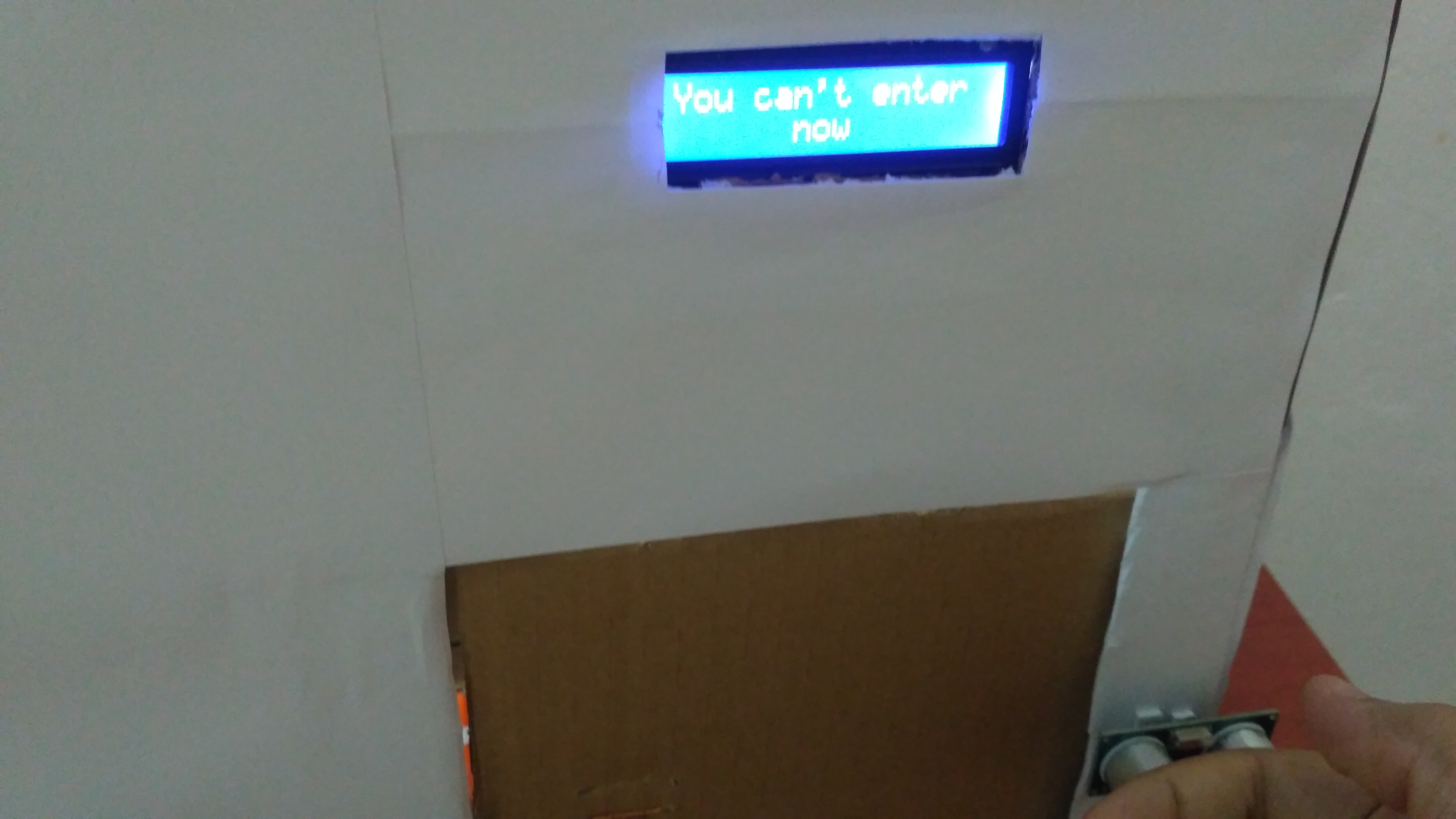
If a person is going to enter the building or vehicle, he/ she can wave or hover his/ her hand over the ultrasonic/ IR tracking sensor module. If an IR tracking sensor module is used, it will send a LOW signal to the Arduino Uno microcontroller and according to my program, the door will be opened.
Before hovering over the sensor, the person can wash his/ her hands using a touchless faucet (https://www.hackster.io/RUCKSIKAA/automatic-faucet-touchless-using-arduino-for-covid-19-369b18).
In my model, I have used a servo motor to open/ close the door. The door will be opened when the servo motor rotates 90 degrees.
If an ultrasonic sensor module is used, the door will be opened when the sensor detects an obstacle within 5 cm away from itself.The door will remain open for 5 seconds and the value stored in the count variable will increase by one after the door is closed. The count variable denotes the number of people inside a building or vehicle.
If the value stored in the count variable reaches the maximum occupancy value, the LCD display module will show that no one could enter and the door will remain closed until someone leaves the building.I have attached an IR tracking sensor module on the inside of the box (modelled as the building/ vehicle) as well. The process will be the same as that mentioned above, but the difference is that the value stored in the count variable will decrease by one as a person is leaving the building.
*Note: The maximum occupancy in this case is the maximum number of people who can enter the building or vehicle without crowding it.
Here's a video showing how this project works:
EXPANDED TECHNICAL DETAILS
Automated Capacity Management
This public health tool helps businesses maintain safe foot-traffic levels by automating the entry process based on real-time occupancy data.
- Inward/Outward Flux Tracking: Uses a pair of Infrared (IR) sensors mounted in the doorway. By logic-gating the sequence of triggers (Sensor A then B = ENTER, B then A = EXIT), the Arduino maintains a precise count of people in the building.
- Safety Interlock Hub: If the "Current Count" exceeds the "Maximum Safety Limit," the Arduino triggers a red "STOP" signal and a physical barrier or high-current alarm.
Remote Monitoring
- Real-Time Data Dashboard: Current capacity is displayed on a high-contrast I2C LCD. (Advanced version) The data is sent via WiFi (ESP8266) to a central manager's smartphone, allowing for centralized oversight of multiple entry points.