Overview
In systems engineering, visualizing the temporal fluctuation of quantitative metrics—be it the frequency of an algorithmic heartbeat or the capacitive decay of a power rail—is essential. Traditional graphical plotting mandates rendering variable amplitude vectors across a horizontal time axis. To circumvent manual observation, this project implements a Miniature Oscilloscope—an algorithmic abstraction device that samples peripheral stimuli via passive probes and dynamically reconstructs the waveform geometries directly onto a local GLCD array, serving as an ad-hoc function analyzer.
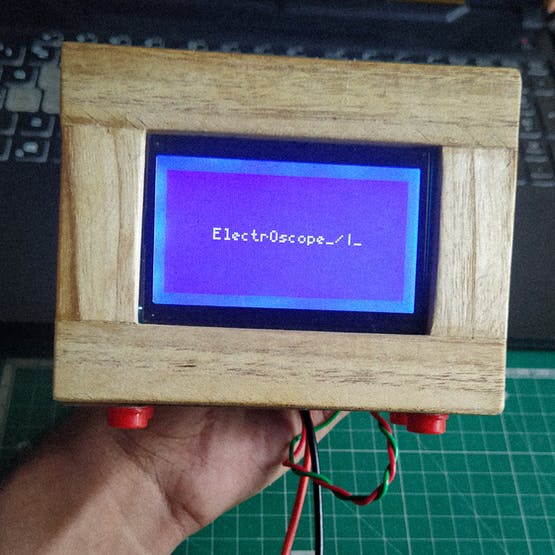
Mechanical Enclosure Fabrication
To maintain structural rigidity and localized shielding, we opted to construct a custom composite chassis using low-density balsa matrices. Lacking additive manufacturing resources (3D printing), standard mechanical reduction protocols were employed:
- Utilizing a hacksaw to dimensionally scale balsa extrusions.
- Employing Fevicol adhesive polymers to securely bond a rectangular containment frame mirroring the GLCD bezel tolerances.
- Conducting excessive mechanical sanding (grit reduction sequencing) to polish the monolithic wooden structure, optimizing user aerodynamics and tactile responses.
Operational Heuristics and Analog-to-Digital Interfacing
Upon interconnecting the localized test probes into a target node, the microcontroller's internal ADC (Analog-to-Digital Converter) executes granular sampling loops across the target vector.
- Sampling Rate & Interval: The operational clock delineates the ADC's data polling throughput (measured in Samples Per Second - SPS). The ATmega328P sequentially buffers consecutive digital voltage quanta into the internal static RAM, caching them as a comprehensive waveform record segment.
- Temporal Scaling (Zoom Simulation): Activating the
Div +veswitch artificially instigates a software delay scalarDelay(T)interpolating consecutive ADC triggers. This artificially broadens the spatial coordinates between sample plots on the GLCD, digitally synthesizing a horizontal field-of-view contraction (Zooming Out). - Peak Detection Forensics: Software iterates across the memory buffer; aggregating logic identifies the maximum analog value registered, which strictly corresponds to the peak amplitude voltage metrics of the transient load.
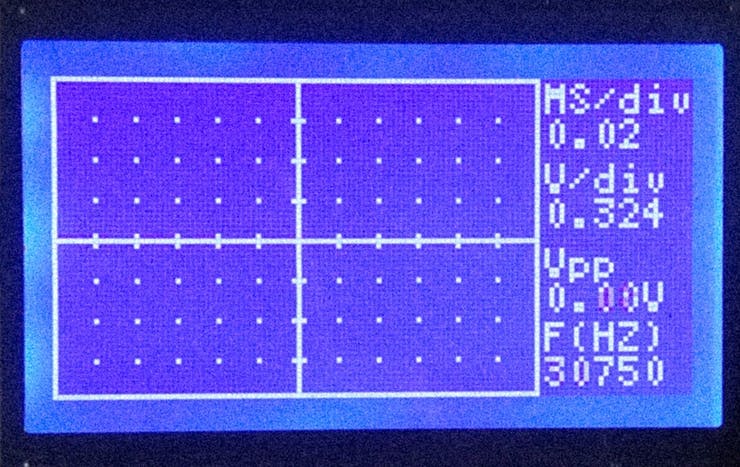
Mathematical data is dynamically flushed onto the Cartesian boundaries of the DISPLAY WAVEFORM domain, while auxiliary diagnostics (derived periodic frequencies, peak electrical loading) are simultaneously written to the adjacent INFO parameters space, cementing a closed-loop analysis ecosystem.