Project Overview
The "Arduino DuinoCoin Miner" project is a fascinating intersection of distributed systems, low-power computing, and blockchain technology. While traditional cryptocurrency mining (like Bitcoin) requires massive specialized hardware (ASICs) or high-end GPUs, Duino-Coin (DUCO) is specifically designed to be "mined" by low-power microcontrollers like the Arduino UNO. This project demonstrates how a simple AtMega328P can participate in a global decentralised network, solving mathematical puzzles for rewards, effectively providing an educational gateway into the mechanics of Proof-of-Work (PoW) without the extreme energy costs.
cryptocurrencies have become more and more popular in the last few years, and the main reason for this is the increase in their value. However, this case should also be taken into account as the value of currency cryptocurrencies increases. The reason for the large number of users and other such factors is increasing. Meanwhile, there are currency codes that, in addition to low prices and lower extraction methods, have an interesting method for extracting or mining, for example DuinoCoin, which we will be able to mine these currency codes using microcontrollers. Visit CiferTechfor more tutorials, and be sure to follow my Instagrampage to support me.
DuinoCoin ᕲ
DuinoCoin is the only coin that can be mined with computers, Raspberry Pi, Arduinos, ESP boards and many other microcontrollers. Supported by a large number of operating systems. It also has a growing and friendly community and is easy to use and exchange. This password can be mined on various systems and also supports Python and C ++ programming languages. Dinoquin has special software wallets and miners released by its developers, this currency code has been in operation since 2019. Also, the transfer and receipt process in DUCO is very easy. In DinoCoin, we first select the desired cryptocurrency pair, for example DUCO to BYND, then fill in the exchange form (username, amount exchanged, etc.) then wait for the exchange. You will be notified of your assets by email.
- Coin supply: 350 thousand
- Block supply: 35 million
- Block time: instant
- Ticker: DUCO (ᕲ)
- Algorithms: DUCO-S1, DUCO-S1A
Arduino board
The Arduino board suite is one of the most popular development boards among embedded engineers, available in various models including Micro, proMini, Nano, Uno, as well as Mega. The core of these popular boards is the AtMega328 series. Arduino is an open source hardware, software and software platform. As mentioned earlier, the Arduino platform includes an open source single-board microcontroller that forms part of the Arduino hardware. In addition, the Arduino platform includes Arduino IDE software designed for programming Arduino boards and a software bootloader that loads on the microcontroller.
Why use DUCO?
Simply put, there is literally no other currency password that supports it. Many people have an Arduino that is just waiting for days to get used to it. Using these small devices in the world of cryptography is an interesting idea. The DUCO team wanted to create something new, innovative and unique, and from the point of view of the community it has assembled, it seems to have made it possible to extract ultra-low-energy devices. DuinoCoin also supports the following boards.
Technical Working Principle
- Mining Algorithm (DUCO-S1): Duino-Coin uses the DUCO-S1 algorithm, which is based on the SHA-1 hash function. SHA-1 is computationally feasible for 8-bit microcontrollers, whereas the SHA-256 algorithm used by Bitcoin is significantly more complex and slower for these chips.
- Kolka System: To prevent "whale" miners (users with powerful PCs) from dominating the network, Duino-Coin implements the Kolka system. This is a reward penalty system that adjusts mining difficulty and rewards based on the device's processing power, ensuring that a simple Arduino remains profitable relative to its energy consumption.
- Communication Bridge: Since an Arduino UNO lacks native internet connectivity, it connects to a "bridge" (typically a Python script running on a PC or Raspberry Pi) via the serial port. The bridge communicates with the pool server to receive "jobs" (puzzles), relays them to the Arduino, and then submits the calculated "shares" back to the network.
- Proof-of-Work Dynamics: The Arduino receives three values: the last block's hash, the target hash, and the difficulty. It then performs a brute-force search (incrementing a nonce) until it finds a value that, when hashed with the block's data, matches the target. Because of the limited clock speed (16MHz), this "hash rate" is very low (usually around 150-180 H/s per Arduino), but the difficulty is tuned to allow for frequent successful shares.
Engineering Insights & Scalability
- Energy Efficiency: A single Arduino UNO consumes approximately 0.2 Watts of power. Compared to specialized mining rigs drawing thousands of Watts, this makes it an excellent platform for learning about sustainable decentralised systems.
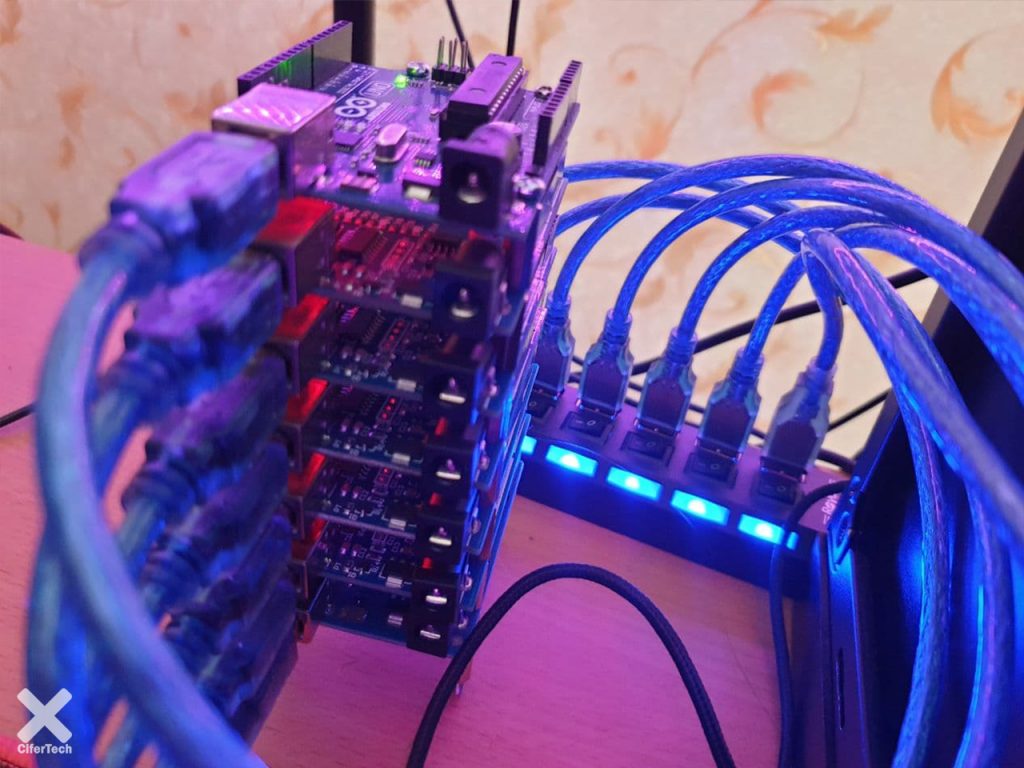
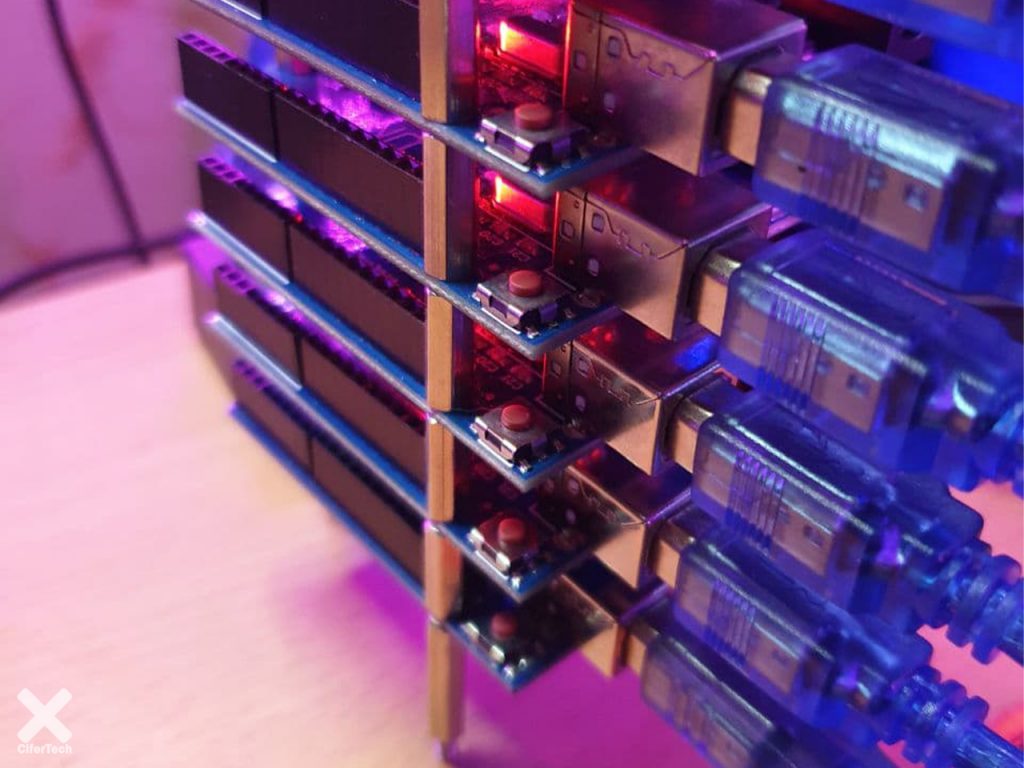
- Multi-Board Rigging: Amateur engineers often create clusters of Arduinos (using an I2C or Serial hub) connected to a single host computer, effectively building a "mining farm" of microcontrollers. This requires advanced knowledge of bus communication and task scheduling to ensure each miner is utilized efficiently without overwhelming the host's serial bandwidth.
- Code Optimization: To maximize the hash rate, the mining code is often written with minimal overhead and avoids floating-point mathematics, focusing purely on high-speed integer operations and bitwise manipulation essential for the cryptographic functions.