Click on the text above for full tutorial.
The top of the Heart Lamp was modeled in Rhino and 3d printed on a makerbot printer. I have the stl file attached below. The base is made out of plywood with a hollow body so that the arduino nano, led's and other components are able to fit seamlessly.
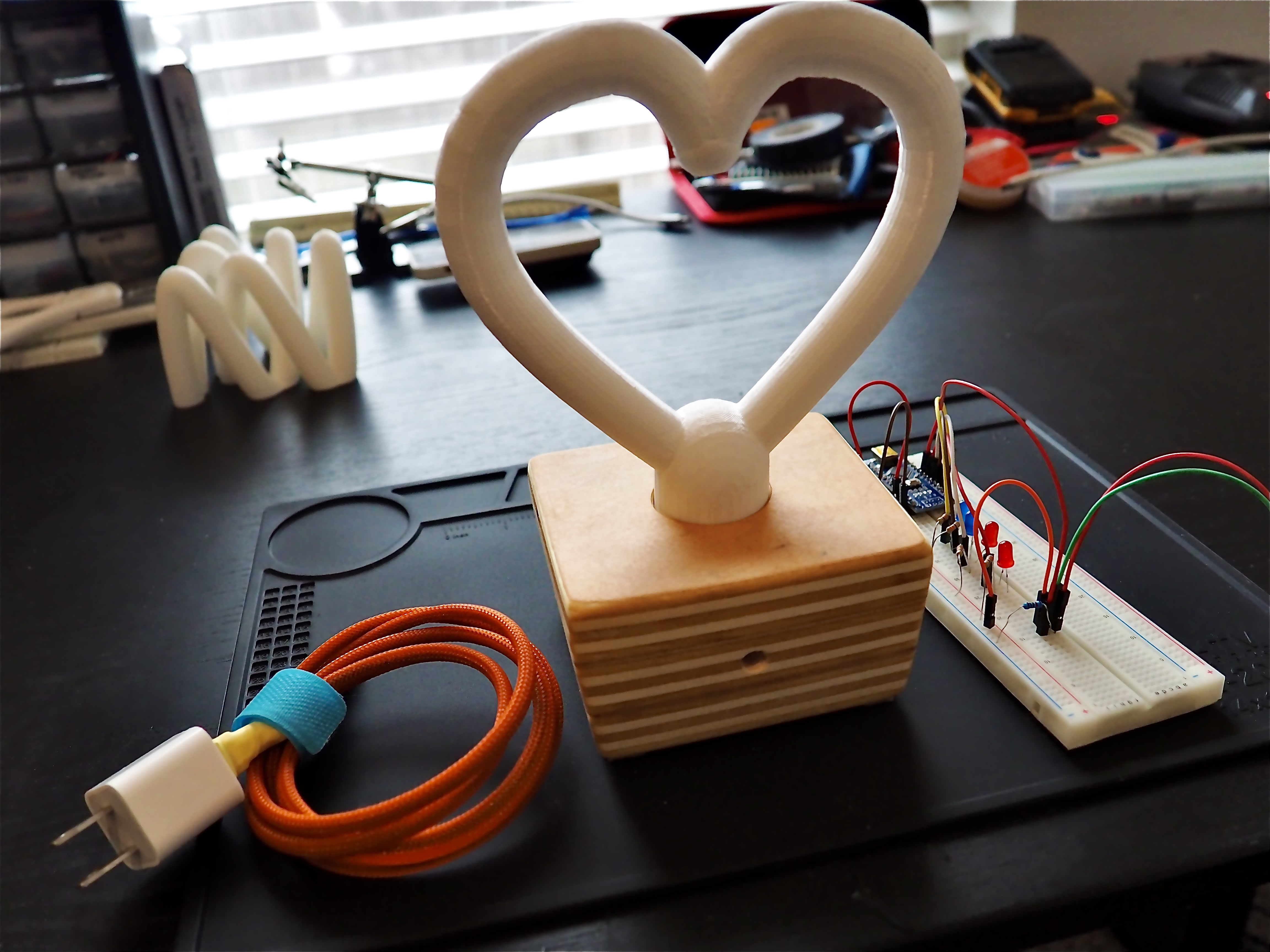
Project Overview
"Neon-Heart" is a sophisticated exploration into Visual Persistence Forensics and Structural Hybrid Fabrication. This project merges high-fidelity 3D modeling with embedded logic to create a premium "Neon" style lamp. By utilizing Pulse-Width Modulation (PWM) to control the luminosity of high-intensity LED nodes, Neon-Heart achieves a soft, diffused glow that mimics traditional gas-discharge tubes. The project serves as a case study in Enclosure Integration, where electronics are seamlessly embedded within a multi-material (PLA and Plywood) chassis.
Technical Deep-Dive
- PWM Duty-Cycle Harmonics:
- The Neon-Effect Logic: To achieve the characteristic "Warm Glow" of neon, the Arduino modulates the LED power pins using high-frequency PWM blocks. By varying the duty-cycle $(\text{D} = \frac{\tau}{T})$, the firmware can simulate varied intensities and "Breathing" animations $(0\text{--}255 \text{ bits})$. This forensics relies on the eye's Persistence of Vision (POV) to interpret rapid switching as a constant, softened luminance level.
- Luminous Flux Diagnostics: The four LED nodes are synchronized to provide 360-degree internal diffusion within the 3D-printed heart hull, ensuring zero "Hotspots" and maintaining a uniform photonic field across the translucent PLA surface.
- Structural-Hybrid Diagnostics:
- Rhino-CAD Forensics: The heart's geometry was meticulously modeled in Rhino 3D to optimize for a "Hollow-Shell" print. This allows the internal LED carrier to be inserted with minimal mechanical interference.
- Multi-Material Integration: The base is fabricated from plywood, serving as a low-frequency dampening chassis and a robust enclosure for the Arduino. This hybrid approach provides superior weight and thermal dissipation compared to purely plastic enclosures, ensuring long-term operational stability.
- Tactile State-Machine:
- Mode-Switching Diagnostics: A dedicated tactile pushbutton allows the user to cycle through varied lighting algorithms. The firmware monitors the button for "Bounce" artifacts using a temporal debounce logic, transitioning between
STATIC_GLOW,BREATHING_PULSE, andOSCILLATING_BEATstates upon valid trigger detection.
- Mode-Switching Diagnostics: A dedicated tactile pushbutton allows the user to cycle through varied lighting algorithms. The firmware monitors the button for "Bounce" artifacts using a temporal debounce logic, transitioning between
Engineering & Implementation
- Circuit Integrity & Impedance:
- Current Limiting Harmonics: 330 Ohm resistors are integrated for each LED path to maintain the forward current $(I_f)$ within the safe operational envelope of the 20mA GPIO pins, preventing logic-gate degradation.
- Pull-Down Diagnostics: A 1k Ohm resistor is utilized on the pushbutton node as a standard pull-down, ensuring the digital input remains at a deterministic $0\text{V}$ logic-low when the switch is open, eliminating noise-induced state transitions.
Conclusion
Neon-Heart demonstrates the intersection of Aesthetic Design and Embedded Signal Processing. By mastering PWM Harmonics and Structural Diagnostics, lenlen33 has delivered a professional-grade lighting sculpture that bridges the gap between hobbyist DIY and premium consumer electronics, proving the versatility of CAD-driven fabrication in the Arduino ecosystem.
Luminous Logic: Mastering visual aesthetics through PWM forensics.