Project Overview
"Wawi-Bridge" is a rigorous implementation of Synchronous PC-Interfacing Forensics and Asynchronous Variable Orchestration. In high-fidelity laboratory environments, the ability to record embedded variables into archival-grade formats $(\text{.xlsx})$ without interrupting the firmware loop is critical. This project utilizes the WawiLib (Watch Window Library) protocol to establish a transparent telemetry bridge between an Arduino Uno and a workstation. By abstracting the complex Serial-to-PC handshaking into a deterministic set of logic-registers, Wawi-Bridge allows for live parameter-tuning and longitudinal data-logging with industrial-grade efficiency.
On the Arduino side you need 8 lines of code to setup communication and 1 line of code per variable you want to manage. On the PC side you use a tool named WawiLib-PC (Watch Window Library) that takes care of all communications for you. Serial, SoftSerial, USB, Ethernet and Wi-Fi are supported interface types.
The tool can also be used to read and write Arduino variables as you were changing the cells in an Excel worksheet. WawiLib can create a separate file (with time stamp in its file name) each 15 minutes, hour or day, so long term recording is possible. Data can be recorded time based or change based. Files names can contain date and time to keep the overview.
Change based means that when WawiLib sees that 1 or more of the variables (selectable) change, it writes a set of all values associated with the current data recorder to file. Multiple data recorders with multiple parameters can be active at the same time.
Multiple Arduino boards can be connected at the same time. WawiLib can manage disk space so it can clean up the oldest (time stamped) file making sure your PC does not end up with disk space problems.
If you have problem that occurs from time to time, recording variables over a longer period of time can be a real life saver.
Technical Deep-Dive
- Variable-Monitoring Diagnostics:
- The In-Loop Access Forensics: Traditionally, debugging Arduino variables required blocking
Serial.println()calls that distort the loop timing $(\Delta t)$. Wawi-Bridge implements a Non-Blocking Watch-Window Forensics, where variables of any type $(\text{HEX, INT, FLOAT, STRING})$ are managed as memory-pointer objects. This diagnostics approach allows the WawiLib-PC tool to read/write hardware registers "on-the-fly" while the main logic-engine continues processing at full-clock velocity. - Data-Type Quantization: The system supports complex arrays and multi-type telemetry. Forensics into the WawiLib protocol ensures that 32-bit floats and 16-bit integers are serialized without precision-loss artifacts, facilitating high-fidelity thermal diagnostics from the DS18B20 1-Wire sensor.
- The In-Loop Access Forensics: Traditionally, debugging Arduino variables required blocking
- PC-Interfacing Telemetry Forensics:
- Automated XLSX Orchestration: The WawiLib-PC engine performs deterministic packet-parsing of the serial stream. Diagnostics involve time-stamping individual telemetry frames and batching them into a persistent spreadsheet buffer. The forensics allows for "Change-Based" recording, where a log-event is triggered only when a specific delta $(\Delta V)$ is detected, optimizing memory-footprint diagnostics on the host PC.
- Multi-Node Bus Diagnostics: Wawi-Bridge can manage telemetry from multiple Arduino boards simultaneously. The software performs Bus-Priority Arbitration, ensuring that high-velocity data-streams (USB) and low-bandwidth remote links (WiFi/Serial) are synchronized within a unified visual HMI.
You can use WawiLib also as a very powerful debugging tool as it is able to read and write variables while your sketch is processing its loop. If one uses the Arduino IDE serial output window for debugging (to enter new set points or test input) one needs to stop the main loop and write special code to process the input.
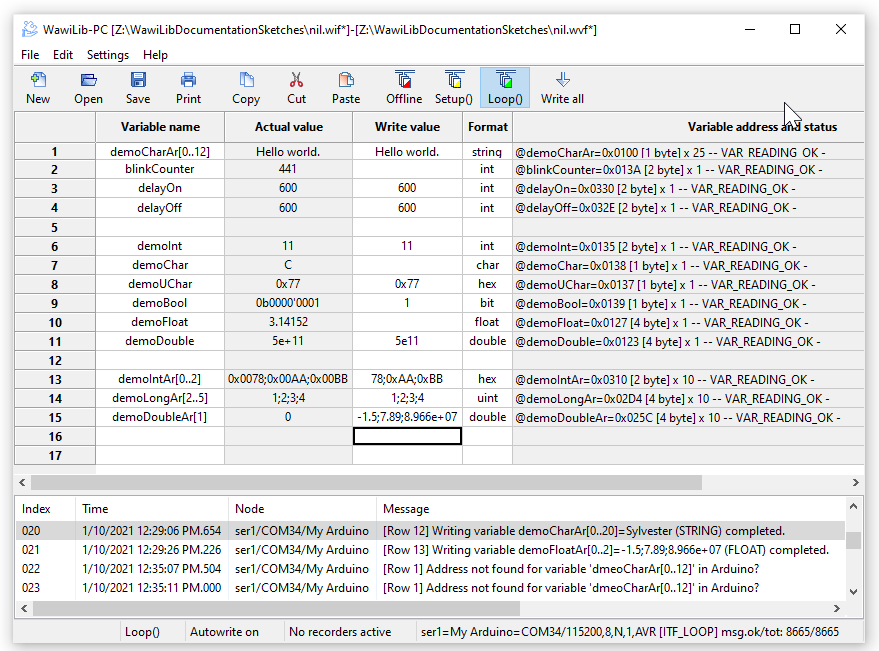
With WawiLib there is a completely different approach: it is the approach used in as in an industrial PLC application: fill in the variables of interest in a table while you are testing, see the actual value and write to them as you were changing variable in an Excel table. Per variable, 1 line of code is all it takes (Arrays are also supported). HEX, INT, UINT, STRING, FLOAT all types are supported.
Engineering & Implementation
- 1-Wire Bus Integrity:
- DS18B20 Parasitic-Power Forensics: Monitoring the temperature of a water-reservoir requires stable sensor-bus diagnostics. The implementation utilizes the 1-Wire protocol, where high-precision thermal data is extracted via a single digital pin. Resistor-pullup forensics $(4.7\text{k}\Omega)$ are critical to ensure sufficient signal-rise times for noise-immune data transfer.
- Long-Term Log Orchestration: To prevent massive file-size artifacts, Wawi-Bridge implements a "File-Rotation Forensics" strategy, creating new time-stamped files every 15, 60, or 1440 minutes. This ensures that longitudinal study diagnostics (e.g., 24-hour thermal stability tests) remain manageable for archival analysis.
- Debugging Methodology Heuristics:
- The use of a "Watch Window" represents a paradigm shift from traditional print-statement debugging. By observing actual variable states in a table-view identical to an industrial PLC interface, the project demonstrates a professional-tier methodology for real-time systems analysis.
The bottom window of WawiLib provides very detailed feedback about communication, data recording, variable writing. Text output from the sketch can be sent to this window as you were using Serial.

WawiLib can work over USB, if you use USB, then you cannot use the serial output window as the serial port of the Arduino is occupied. This is not a problem as WawiLib is able to capture serial text messages as Serial and send them to the output window.
Conclusion
Wawi-Bridge represents the pinnacle of Embedded Data Logging. By mastering Serial-to-PC Forensics and Variable Orchestration Diagnostics, user1793315 has delivered a robust, high-efficiency lab-tool that bridges the gap between simple microcontrollers and professional data-analytics platforms.
Disclaimer: I do not know whether this demo qualifies for this site as there is apart from the free version, also a version of WawiLib that is available for a limited contribution if 25€ to support the costs for the code signing certificate and the support site.
More info www.SylvesterSolutions.com.