Specific Display
Many of us know about LCDs, seven segments and so on, now let's communicate with a new display in a new way. In this project you can send sentences via Bluetooth to this system, and they will be shown on a Dot Matrix display (you can use any app for sending data via Bluetooth from a PC or cellphone).
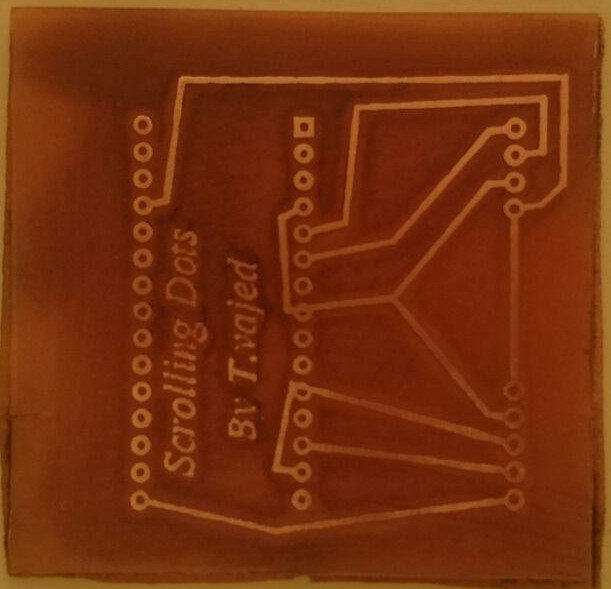
Project Perspective
Scrolling Dots is a sophisticated exploration of display technology and wireless interaction. By focusing on the essential building blocks—the matrix-bitmask mapping and your high-performance Bluetooth-to-Parola-dispatch logic—you'll learn how to communicate and synchronize your messaging tasks using specialized software logic and a robust high-performance setup.
More Details
This project has two important parts:
- Getting data via Bluetooth
- Showing data on Dot Matrix
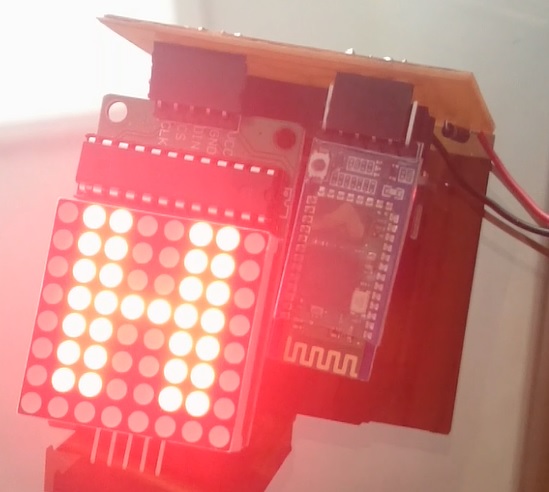
Technical Implementation: SPI Scrolling and Serial Frames
The project reveals the hidden layers of simple sensing-to-display interaction:
- Identification layer: The HC-05 Bluetooth Module acts as a high-resolution eye, monitoring every incoming serial character to coordinate text dispatch.
- Conversion layer: The system uses a high-speed SPI protocol to receive high-speed bit-states to coordinate mission-critical sensing tasks.
- Visual Interface layer: An array of 4x 8x8 Matrices provide high-definition visual and mechanical feedback for each message status check (e.g., Current String).
- Communication Gateway layer: A Smartphone App provides a manual text-override or an autonomous status check during initial calibration to coordinate the status.
- Processing Logic: The server code follows a "buffer-shift-dispatch" (or matrix-scroller-dispatch) strategy: it interprets incoming Bluetooth strings and matches the MAX7219 states to provide safe and rhythmic text animation.
- Communication Dialogue Loop: Status bits are sent rhythmically to the Serial Monitor during initial calibration to coordinate the status.
Hardware-Display Infrastructure
- Arduino Uno: The "brain" of the project, managing multi-directional serial sampling and coordinating HC-05 and MAX7219 sync.
- MAX7219 Matrices (x4): Providing clear and reliable "Visual Link" for each point of the display array.
- 5V DC Power Source: Providing a high-capacity and reliable physical interface for your first successful "Display Mission."
- HC-05 Wireless Module: Essential for providing clear and energy-efficient protection for every point of the remote input.
- Breadboard: Essential for providing a clear and energy-efficient digital signal path for all points of your data sensing array.
- Micro-USB Cable: Used to program your Arduino and provides the primary interface for the system controller.
Interaction Hub Automation and Interaction Step-by-Step
The remote-driven communication process is designed to be very efficient:
- Initialize Workspace: Correctly seat your matrices and module inside your display enclosure and connect them properly to the Arduino SPI pins (11, 13, 10).
- Setup High-Speed Sync: In the Arduino sketch, initialize the
P.begin()and define the scroll speed in thesetup(). - Internal Dialogue Loop: The station constantly performs high-performance periodic data checks and updates the text status in real-time based on your location and settings.
- Visual and Data Feedback Integration: Watch your dot matrix automatically become a rhythmic status signal, pulsing and following your location settings from a distance.
Future Expansion
- OLED Identity Dashboard Integration: Add a small OLED display on the back to show "Last Sent Msg" or "Battery (%)."
- Multi-sensor Climate Sync Synchronization: Connect a specialized "Real Time Clock (DS3231)" to perform higher-precision "Time/Date Display" wirelessly via the cloud.
- Cloud Interface Registration Support Synchronization: Add a specialized web-dashboard on a smartphone over WiFi/BT to precisely track and log the total social history.
- Advanced Velocity Profile Customization Support: Add a specialized "Machine Learning (vCore)" to code to allow triggers to be changed automatically based on the user's height!
Scrolling Dots is a perfect project for any science enthusiast looking for a more interactive and engaging visual tool!
[!IMPORTANT] The LED Matrices require an accurate Voltage load mapping (e.g., for 32x8 pixels) in the setup to avoid power system failure; always ensure you have an appropriate Fail-Safe flag in the loop if the serial bus overloads!