This project is simply to keep the plants healthy, continuously, through the automation of this greenhouse. the desired parameters, such as the internal temperature, the humidity of the air as well as that of the ground; are adjustable by means of a potentiometer and an LCD screen.
The primary goal of this project is to automate a greenhouse, using Arduino. The location of the plants is continuously irrigated and ventilated to keep the temperature and humidity perfect. The arduino system is based mainly on an Arduino Uno R3 board, which allows to analyse and control the conditions necessary for plant development. several sensors are essential:
- humidity and air temperature sensor
- soil moisture sensor
Thus, this greenhouse works by gathering the collected data, which will then be processed in order to activate certain mechanisms so that the plant are healthy.
I/ The greenhouse itself :
To build the Greenhouse you will need :
- OSB plate 3: (800*600)
- OSB plate 3: (600*600)
- Raw MDF cleat: (16*16*610 (*4) )
- Raw MDF cleat: (16*16*670 (*2) )
- MDF cleat raw: (16*16*540 )
- Salvage wood / OSB 3: (725*135 (*2) )
- OSB plate 3:( 585*135 )
- Wood rod: (580*4*18 (*2) )
step 1: Start building your greenhouse by fix your first two plates : the 600*600 one as your fondation and the 800*600 one as the "back wall" of your greenhouse
that being done we can keep going with the cleats
Steps 2 : With the greenhouse facing you place 2 Raw MDF cleats: 16*16*610 verticaly in each of the closest corners of your fondation (red)
Then fix horizontaly 2 : 16*16*670 cleat linking the 2 previous cleats to the back plate (green)
fix your 16*16*540 strip between your two vertical cleat to finish your the roof frame of your greenhouse (blue)
finally fix your 2 last 16*16*610 cleat verticaly to the back of our greenhouse, they will be useful later when we will need to fix our borders
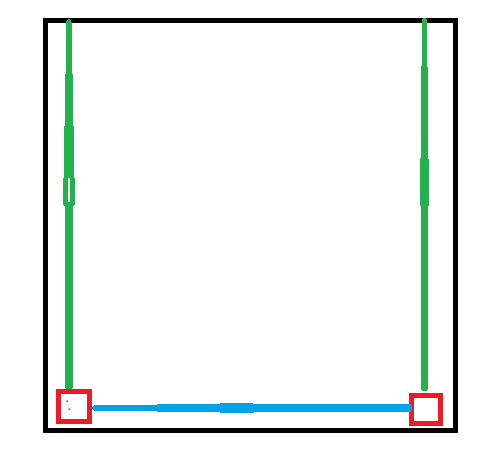
after using out all our strips its time to use some salvaged wood and the scraps of our plates to do the border:
Fix the 2 Salvage wood / OSB 3: 725*135 on the sides
and the 585*135 plate on the front (it is good to know that we did 2 rectangular holes : 1 for our LCD screen (13,5*3,5cm) and one for our potentiometer and buton (1*13cm)) Like so :
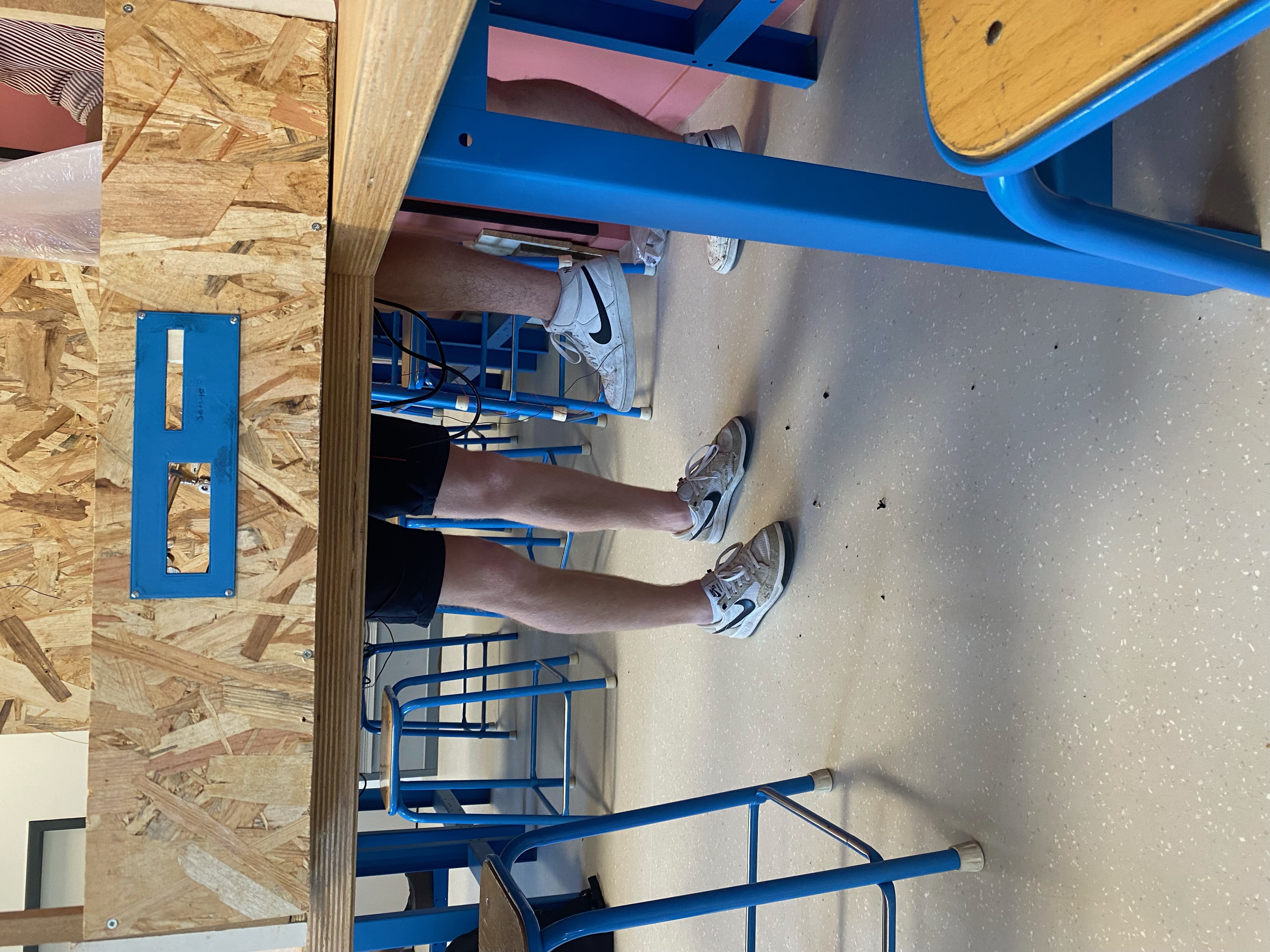
Step 4: The roof and watering system
To finalize our roof lets fix horitaly our two wood rods (580*4*18) and place our watering system composed of catether and garden nozzle
like that :
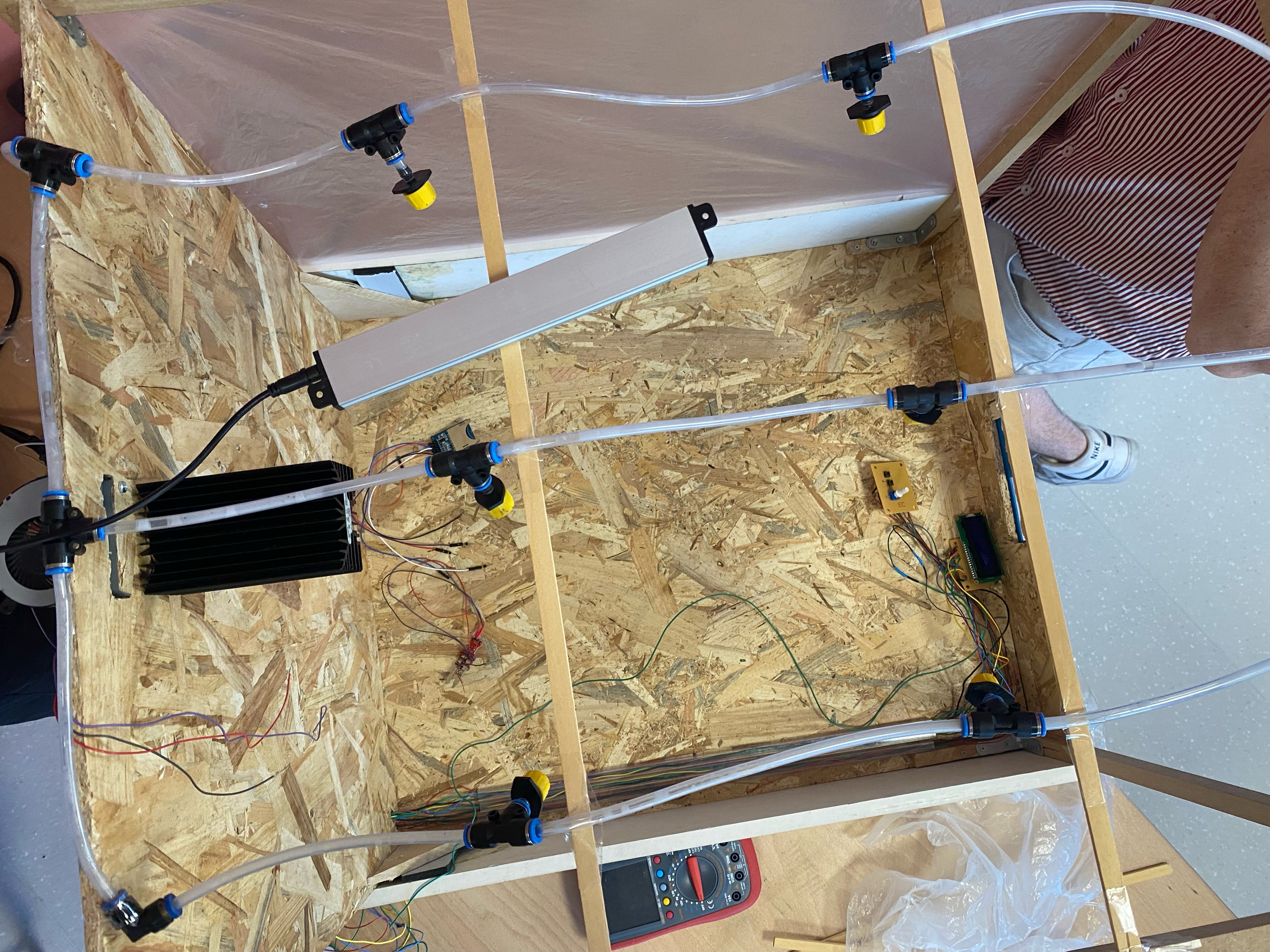
the greenhouse part is now done, the most interesting part : the autonomous part.
II/ Atomation:
For this part we will need:
- Arduino UNO
- Pc fan
- sensor(humidity,temperature)
- heating resistance
- submersible pump
- lamp (LED)
- wires
- LCD Screen
- potentiometter
- buton
Most of the cabling is taking place a the back of the greenhouse and everything is powered from a power strip, try to do a cabling consistent with the program given or change the programm your way . (also try to build location for all the components)
The LCD screen , its potentiometter and buton are however taking place at the front of our creation in their dedicated spaces.
as regards our water tank a water bottle does perfectly.
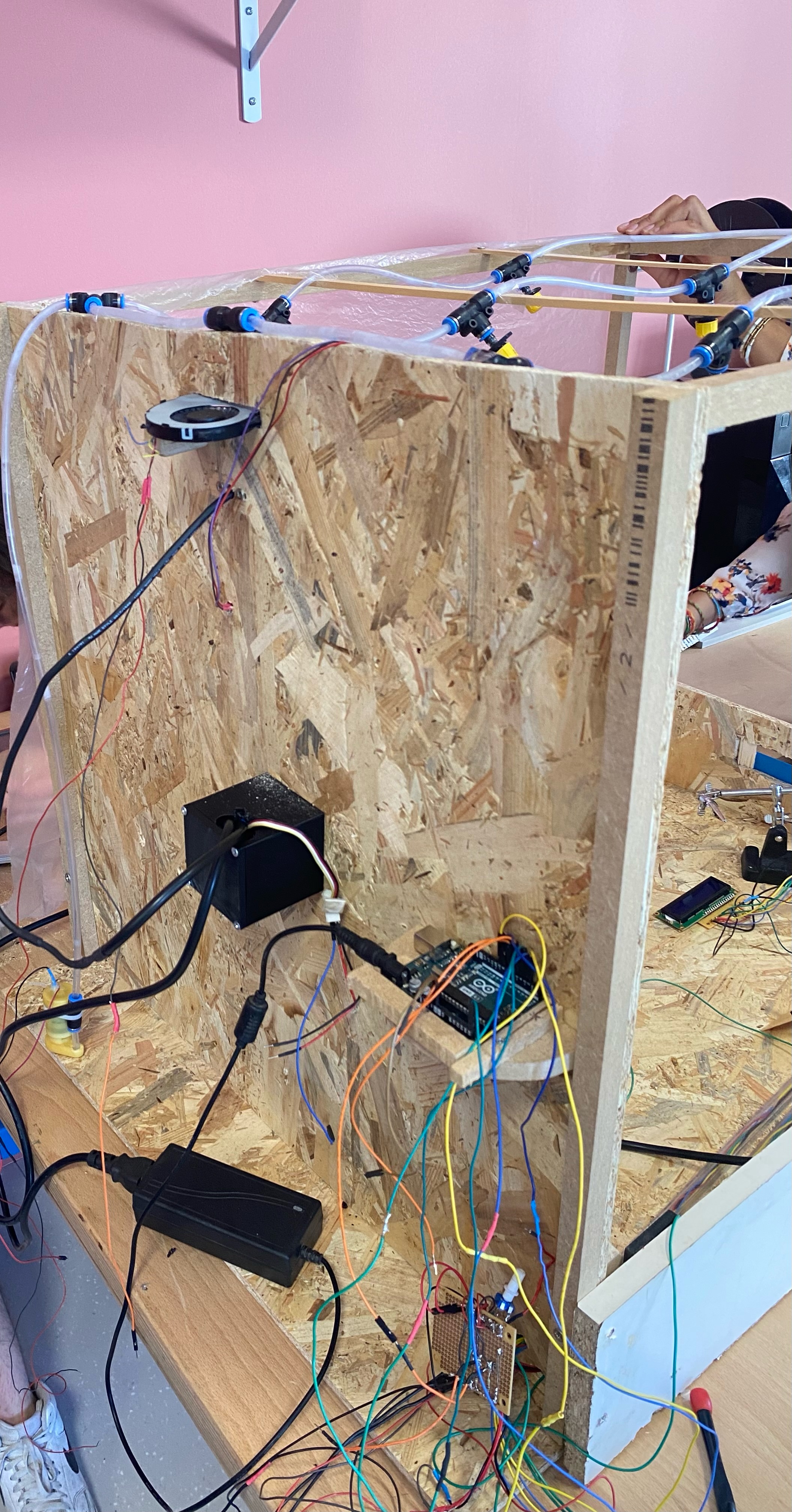
EXPANDED TECHNICAL DETAILS
Advanced Climate Control System
Serrje is a high-performance, fully autonomous greenhouse management system that optimizes plant growth through precise environmental regulation.
- Micro-Climate Monitoring: Utilizes a suite of high-accuracy sensors, including the SHT31 for ambient temperature and humidity, and a capacitive soil moisture sensor to prevent root rot through over-watering.
- Multistage Actuation: The Arduino (often an ESP32 for cloud connectivity) controls high-current peripherals through a series of solid-state relays, managing a 12V ventilation fan, a 24V water pump, and a full-spectrum LED lighting array.
Intelligent Feedback Loops
- PID-Controlled Environment: Features a PID (Proportional-Integral-Derivative) algorithm to maintain a rock-steady temperature profile, adjusting fan speeds incrementally rather than just on/off.
- Remote Dashboard: Synchronizes real-time data to a mobile app via WiFi, allowing users to adjust growth parameters from anywhere in the world.