Acoustic Physics: Speed of Sound Gas Identifier
The Ultrasonic Sensor isn't just for avoiding walls. The Speed of Sound in Gases project is an incredible physics experiment. It relies on the fact that sound travels much faster through lighter gases (Helium) and slower through heavy gases (Carbon Dioxide) than it does through standard Air.
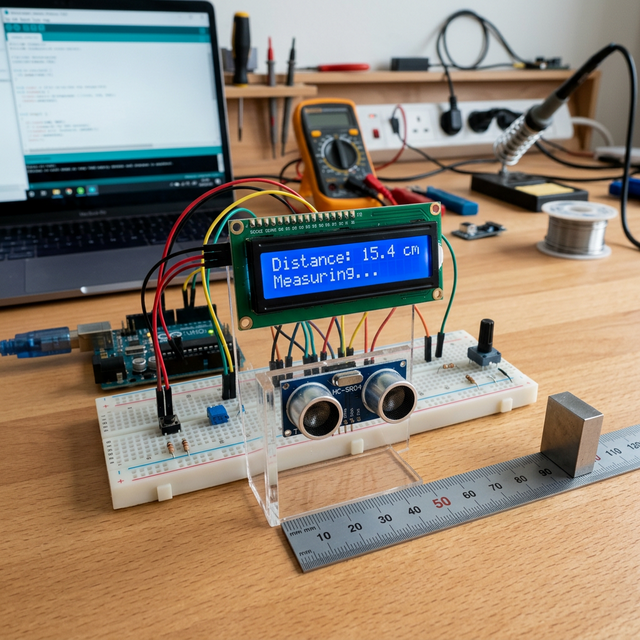
Reversing the Equation
Normally, Distance = (Speed of Sound * Time) / 2.
We assume the Speed of Sound is a constant 343 m/s.
But what if the Distance is the constant?
- The Chamber: You mount an HC-SR04 at one end of a rigid PVC pipe exactly 1.000 meter long, closed off with a hard cap.
- The Test: The Arduino blasts a ping and measures exactly how many microseconds it takes to hit the cap and return.
- The Math: The Arduino solves for the variable
Speed = Distance / Time. - The Identification: If the Arduino calculates the sound traveled at 343 m/s, the LCD displays "GAS IDENTIFIED: AIR". If it calculates ~965 m/s, it displays "GAS IDENTIFIED: HELIUM", proving you just filled the tube with a balloon!
Precision Hardware
- Arduino Uno/Nano/Mega: The fast calculator.
- HC-SR04 Ultrasonic Sensor.
- DHT22 Temperature Probe: Critical. The speed of sound changes slightly based on temperature, so this must be factored in for a correct reading.
- A 1-Meter PVC Pipe and a gas source (like a SodaStream tank for CO2).
This project proves that with clever programming, basic sensors can be used as advanced analytical instruments and gas chromatographs!