Multi-Output Systems: The Talking Matrix Clock
The Talking Alarm Clock is a masterclass in combining completely different technology stacks into one cohesive box. It requires managing huge SPI display arrays for visuals, an I2C Real-Time Clock for logic, and Serial audio MP3 commands to synthesize human speech.
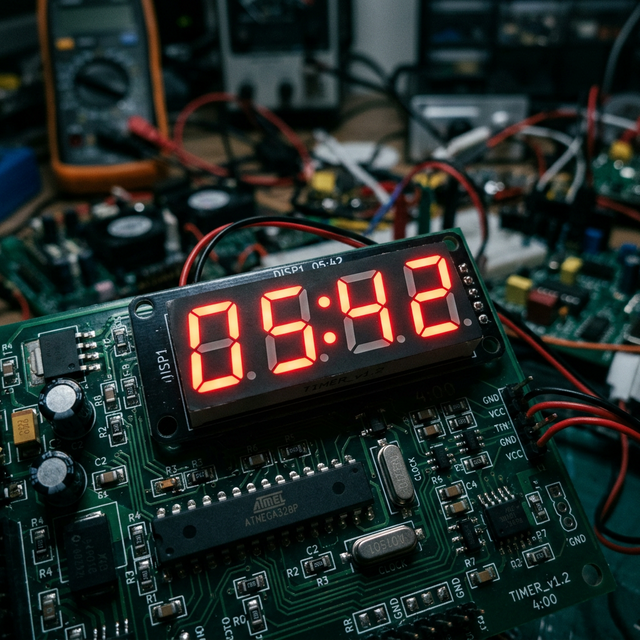
The Matrix Display (Visuals)
A 4-digit 7-segment display is boring. This clock uses four 8x8 Matrix Modules daisy-chained together (a 32x8 resolution screen).
- The MAX7219 libraries allow for massive, blocky fonts.
- It can also scroll the date:
Thursday, October 12thsmoothly across the entire face of the clock when the user presses an arcade button on the top. - The code actively queries the DS3231 RTC Module every second to ensure the matrix is perfectly synced.
Synthesizing Speech (Audio)
How does it "Talk"? You cannot easily run true Text-to-Speech (TTS) algorithms on a tiny Uno.
- The Brute Force Audio Dictionary: You use a PC to record a human voice saying 60 different
.WAVor.MP3files.01.mp3= "It is"02.mp3= "One"15.mp3= "O'clock"
- You place all 60 files on a MicroSD card inside a DFPlayer Mini Module.
- The Assembly Algorithm: When the alarm triggers, or when the user "claps" their hands (detected by a Sound Sensor module), the Arduino executes a chain of serial commands:
myDFPlayer.play(1); delay(1000);("It is")int hour = rtc.getHour(); myDFPlayer.play(hour); delay(1000);("Seven")myDFPlayer.play(15);("O'clock").
- By dynamically queuing the MP3s based on the math variables, the clock acts like it's speaking sentences!
Base Hardware Elements
- Arduino Mega or Uno.
- MAX7219 4-in-1 Dot Matrix Display.
- DS3231 RTC Module.
- DFPlayer Mini MP3 + 3W Speaker.
- Sound Sensor (Microphone) to detect a clap to wake up the clock face!