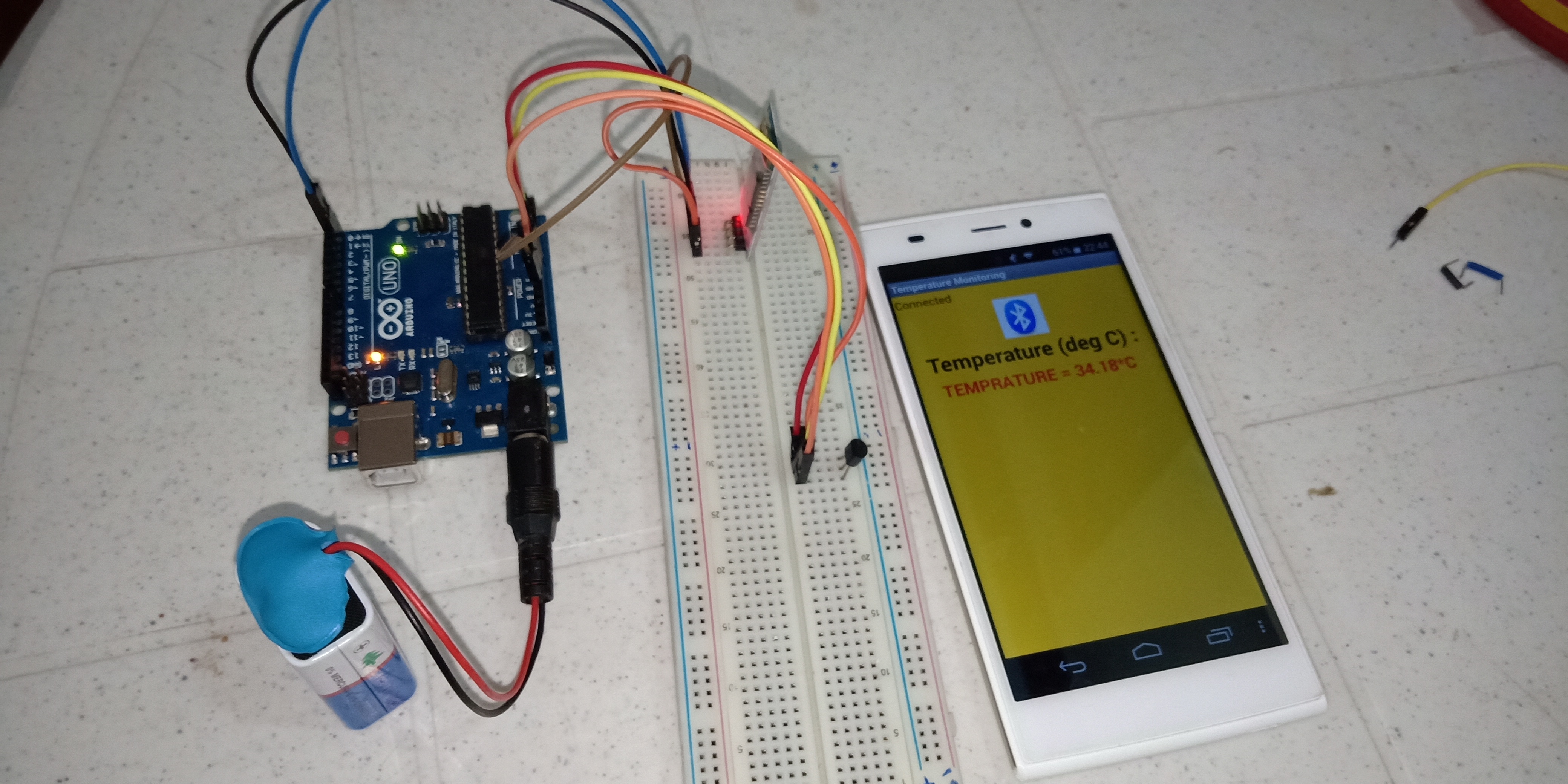
This project is the definitive Masterclass in Wireless Data Telemetry and Mobile Visualization Architecture. The Temperature Monitoring System is a high-performance Sensing-to-Smartphone Workstation designed to establish a remote "Process Monitoring HUD" without expensive long-range cabling. By leveraging LM35 High-Precision Analog Logic and the **HC-05 Transparent Bluetooth Bridge**, this project empowers you to build a sophisticated telemetry asset that manages real-time environmental data and Android character-rendering with high-speed wireless reliability.
Telemetry Infrastructure and Wireless Architecture Overview
The Mobile Monitoring Framework functions through a specialized Sense-Encode-Stream lifecycle. The system is built on a high-reliability Transparent Data Model:
- LM35 Precision Analog Shunt: The "Perceptual Hub Node." The LM35 is an Integrated-Circuit Temperature Sensor that provides a linear voltage output proportional to Celsius (10mV/°C). The Arduino polls this value at a 10-bit resolution, transforming raw electrical current into a meaningful thermal data-packet.
- HC-05 Bluetooth Serial-Rail: The hardware bridge. The HC-05 acts as a Wireless Virtual COM Port. By connecting the Arduino’s TX/RX pins to the module, the code streams ASCII character data over the 2.4GHz radio band, providing a professional-grade "Zero-Cables" serial link to any paired phone.
- Android Visualization Matrix: Through the specialized TemperatureMonitoring.apk, the mobile device acts as a handheld dashboard. It parses the incoming serial stream and renders the numerical data onto a high-fidelity visual UI, providing a professional and interactive user experience.
Hardware Infrastructure & The Precision Tier
- Arduino Uno R3 (The Command Brain): A chosen stable microcontroller that acts as the Analog-to-Serial Gateway, coordinating the timing between sensor ADC (Analog-to-Digital) conversion and asynchronous UART Bluetooth packets.
- LM35 Precision Sensory Node: Specifically selected for its 0.5°C Accuracy. It acts as the primary telemetry input, providing a stable, non-noisy voltage signal even in varied industrial environments.
- HC-05 Wireless Transparent-Bridge: The "Communication Hub Node." Configured for 9600-Baud serial transmission, it provides a stable logic link between the 5V Arduino environment and the 3.3V smartphone radio protocol.
- Integrated "Safety-First" Wiring Matrix: The system includes a critical UART-Isolation Protocol. To ensure firmware upload stability, the user must disconnect the Bluetooth RX/TX lines during the boot-loader cycle, a professional-level hardware best-practice.
Technological Logic and Execution Algorithms
The system reaches professional-grade reliability through several Firmware Orchestration Strategies:
- ADC-to-Celsius Calibration Shunt: The firmware includes a Mathematical Conversion Logic:
(voltage * 100.0) / 1024. This translates the raw 0-1023 analog reading into a high-precision decimal temperature signal. - Asynchronous Stream Modulation: The code avoids blocking delays, sending a data-packet every 500ms to ensure a "Fluid Telemetry" feeling on the smartphone app without overwhelming the Bluetooth buffer.
- Signal Smoothing Filter: By averaging multiple analog samples before transmission, the system eliminates Transient Electrical Noise from the LM35, providing a rock-solid temperature profile on the Android HUD.
- Hardware Scalability: Validated for temperature, this modular architecture is "Multi-Process Ready," with the option to add gas sensors, humidity nodes, or light-level telemetry using the same transparent Bluetooth rail.
Why This Project is Important
Mastering Bluetooth Telemetry and Handheld Data Visualization is an essential skill for IoT Engineers and Mobile App Developers. It teaches you how to design a "Remote-Aware" system that bridges the gap between physical sensor hardware and high-level mobile software—a critical skill for designing industrial monitors, health trackers, and smart-home dashboards. Beyond simple thermometers, these same principles are used in Wireless Engine Diagnostics, Patient Monitoring Systems, and Remote Laboratory Telemetry. Building this project proves you can engineer a professional-grade monitoring asset that prioritizes sensor accuracy, wireless stability, and user-centric visualization.
Technical Engineering Tip: Make sure your LM35 is properly grounded to the Arduino GND. If your readings are "jumping" inconsistently on the phone app, it’s often due to "Ground Loop Interruption"; ensuring a solid common-ground connection for both the sensor and the Bluetooth module will fix 90% of telemetry noise issues.