Have you ever been curious about the color of something in your world? 'The RGB Revealer' can help you crack the color code. This project explores color data by combining the power of Arduino with a TCS3200 color sensor and a TFT display.
Project Overview
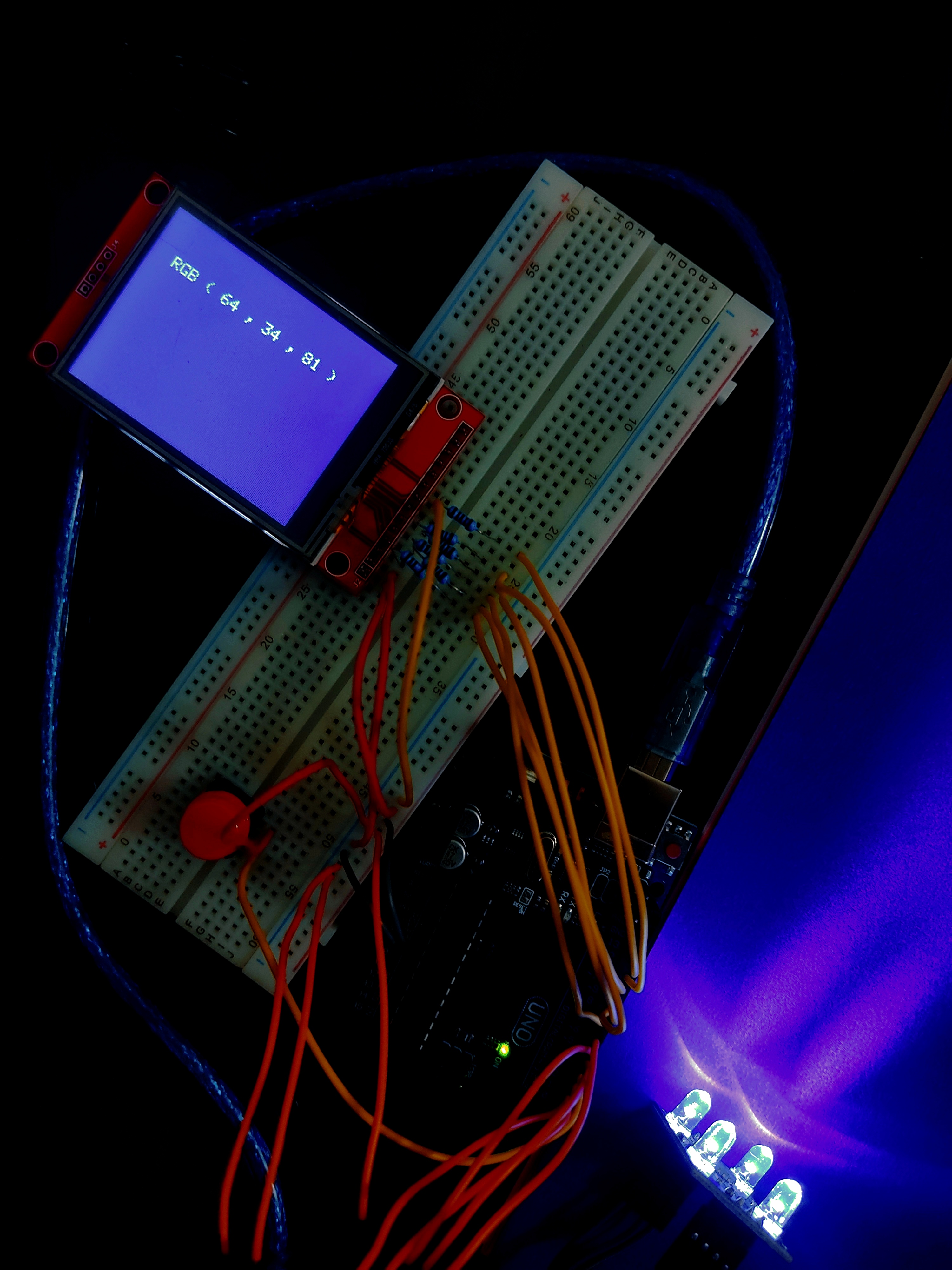
The "Chromatic Eye: Portable RGB Analyzer" is a handheld instrument that translates the physical world into digital data. By combining the TCS3200 light-to-frequency converter with a high-resolution ILI9341 TFT display, this device allows users to "sniff" the color of any object—from paint swatches to fabric—and see the exact 24-bit RGB code rendered in real-time. This project is a foundational study in spectroscopic sensing, SPI display protocols, and high-speed signal processing.
Working:
Point the color sensor at any object and press the connected push button. The sensor analyzes reflected light and determines the approximate RGB (Red, Green, Blue) values that make up the color. The estimated RGB value will be displayed on the bright TFT display.
Technical Deep-Dive
- The TCS3200 Light-to-Frequency Converter:
- Photodiode Array: The sensor contains an 8x8 matrix of photodiodes: 16 with red filters, 16 with green filters, 16 with blue filters, and 16 with no filter (clear).
- Frequency Output: Unlike analog sensors that output voltage, the TCS3200 outputs a square wave whose frequency is directly proportional to light intensity. The Arduino uses the
pulseIn()function to measure the period of these waves, allowing for ultra-precise intensity calculation that is immune to analog electrical noise.
- RGB Color Space Mapping:
- The 8-bit Scale: The raw frequency counts from the sensor are mapped to a standard 0-255 range using the
map()function. This calibration must be performed by sampling "Absolute Black" and "Absolute White" surfaces to define the lower and upper bounds of the sensing window.
- The 8-bit Scale: The raw frequency counts from the sensor are mapped to a standard 0-255 range using the
- SPI Display Interface (ILI9341):
- High-Speed Rendering: The ILI9341 communicates via the Serial Peripheral Interface (SPI). To render the sampled color, the Arduino sends a 16-bit color value (565-format: 5 bits Red, 6 bits Green, 5 bits Blue) to the display controller at a 10MHz+ clock rate, ensuring that the screen updates instantly when the "Reveal" button is pressed.
- Chromatic Accuracy & Shielding:
- Dark-Level Bias: Light-to-frequency sensors are highly sensitive to ambient light. The hardware design includes a mechanical "shroud" around the TCS3200 LEDs. This ensures that the sensor only sees the reflected light from its own white LEDs, providing a consistent "controlled environment" for every reading.
Uses:
This project is a fun way to decode the world in terms of RGB values. It can be a starting point for color matching in design projects. While the exact match might be off, it gives an approximate RGB value to reference.
Engineering & Implementation
- Non-Blocking Interrupt logic: The push button is used to trigger a "Capture Event." Instead of continuously sampling, which can wash out the TFT display with serial noise, the firmware remains in a standby state until the user presses the button, providing a stable and professional user experience.
- Calibration Variables: Because every TCS3200 chip has a slightly different manufacturing tolerance, the code features
redMin,redMax, etc., as global variables. This allows the maker to fine-tune the "Accuracy" of the revealer by adjusting these values based on benchmark colors like pure white paper. - Power Optimization: The 2.4" TFT backlight can draw significant current (up to 80mA). The project utilizes the Arduino's 5V rail with appropriate current-limiting resistors to protect the UNO's linear regulator while maintaining display vibrance.
- Scalability for Design: This tool is particularly useful for graphic designers and interior decorators. By capturing "Real World" colors and displaying the hex code (e.g., #FF5733), users can bring physical textures directly into digital Adobe or CSS workflows.
Further Exploration
The project includes well-commented Arduino code. You can tinker with the code and potentially customize it for further exploration! We also encourage you to explore ways to further improve the color accuracy. Share your findings with the community!