Utilizing Arduino as the brain, this product transforms auditory rhythms into a visual spectacle through music-reactive LED strip lights. Crafted with meticulous coding for precise light responses, adept soldering to forge the circuit's backbone, and innovative 3D printing to encase the electronics in a custom-designed, aesthetically pleasing housing, this product offers an immersive experience. It blends sight and sound, inviting the audience into a world where music is seen as vividly as it is heard.
Regardless of the genre of music, this music-reactive LED strip will react to the bass, beat, and lyrics to a song. With a 5-meter long 12V WS2811 LED strip, a 12V 5A AC DC converter was used to power the LED lights. To optimize users' experience, the code offers two styles of the LED lights reacting. The first style is "linear-reactive" where the lights are already lit up from one side and builds up to the other side based on how loud the bass/beat/lyrics are. The second style is "brightness-reactive" where the lights are all lit up but will shine brighter depending on how loud the bass/beat/lyrics are.
Converting Sound to Light
The core functionality is based on a process of converting sound into a visual output. Here's how it works:
- The Input: An analog sound sensor (like the KY-037 or a MAX4466 microphone) constantly reads the noise envelope of the room. This sensor captures the audio signal, including the bass, beat, and vocals.
- The Logic: The Arduino reads the analog values from the microphone. The code is designed with specific thresholds for bass, mid-range, and treble. When the incoming audio signal crosses a defined "Bass Threshold" or other frequency-based thresholds, it triggers a corresponding output pattern.
- The Output: For the "linear-reactive" style, the Arduino controls the addressable LEDs to light up sequentially, with the length of the lit section proportional to the audio amplitude. For the "brightness-reactive" style, it uses Pulse Width Modulation (PWM) via
analogWrite()principles (managed by the FastLED or NeoPixel library) to vary the brightness of all LEDs simultaneously based on the sound intensity. High volume equals more LEDs or brighter illumination.
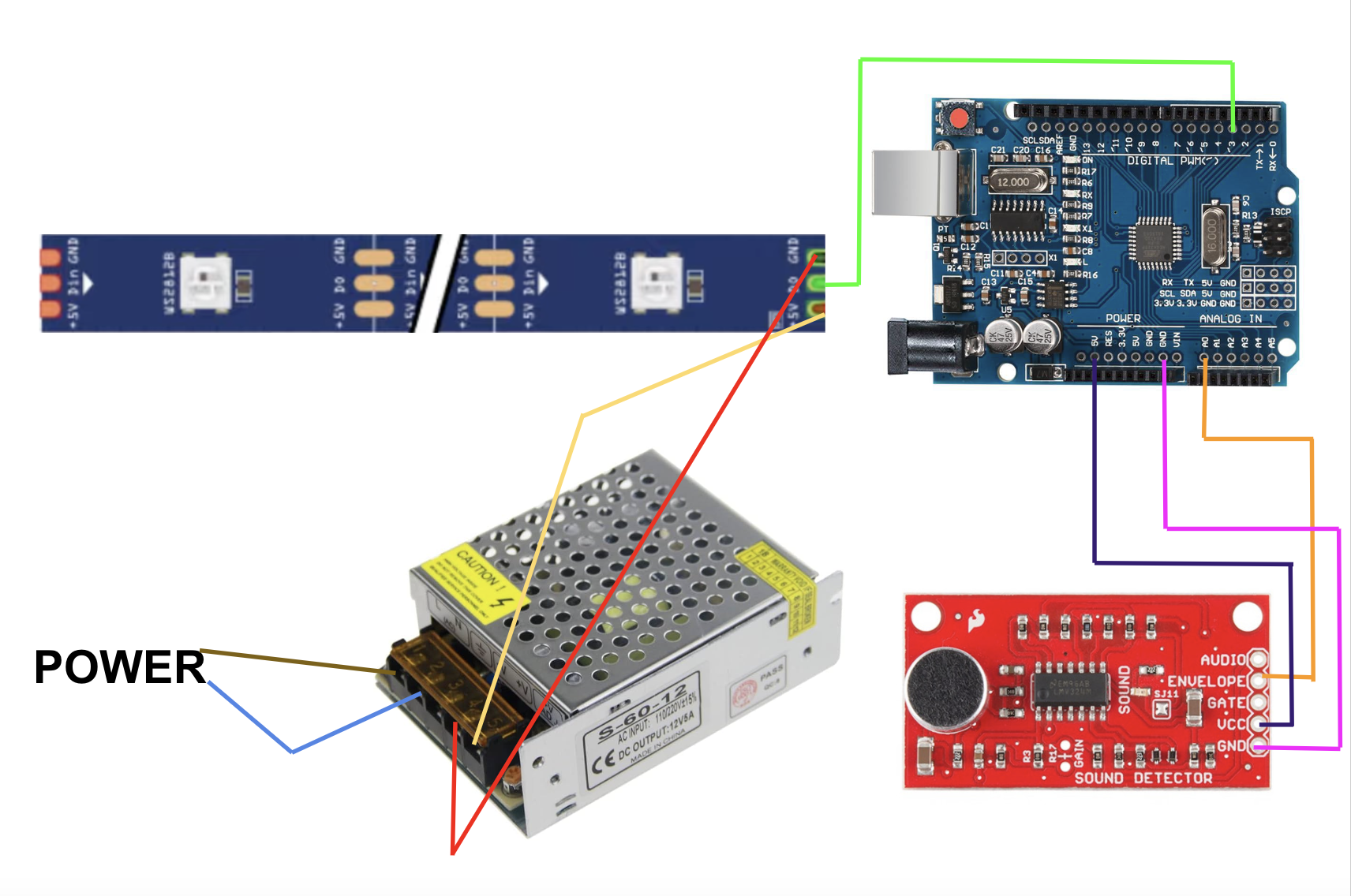
Hardware Foundation
The project is built on a specific hardware setup to achieve its effects reliably:
- Arduino Uno: Acts as the central processor.
- Addressable LED Strip: A 5-meter long 12V WS2811 strip provides the visual output.
- Power Supply: A 12V 5A AC/DC converter is essential to provide sufficient current for the full length of LEDs at high brightness.
- Sound Detection Module: A module like the KY-037 is used to feed the audio signal to the Arduino's analog pin.
Just plug in your AC DC converter to a power source and connect your Arduino Uno to the LED strip & sound detector... you can enjoy this music-reactive LED strip and decorate it anywhere in your room!