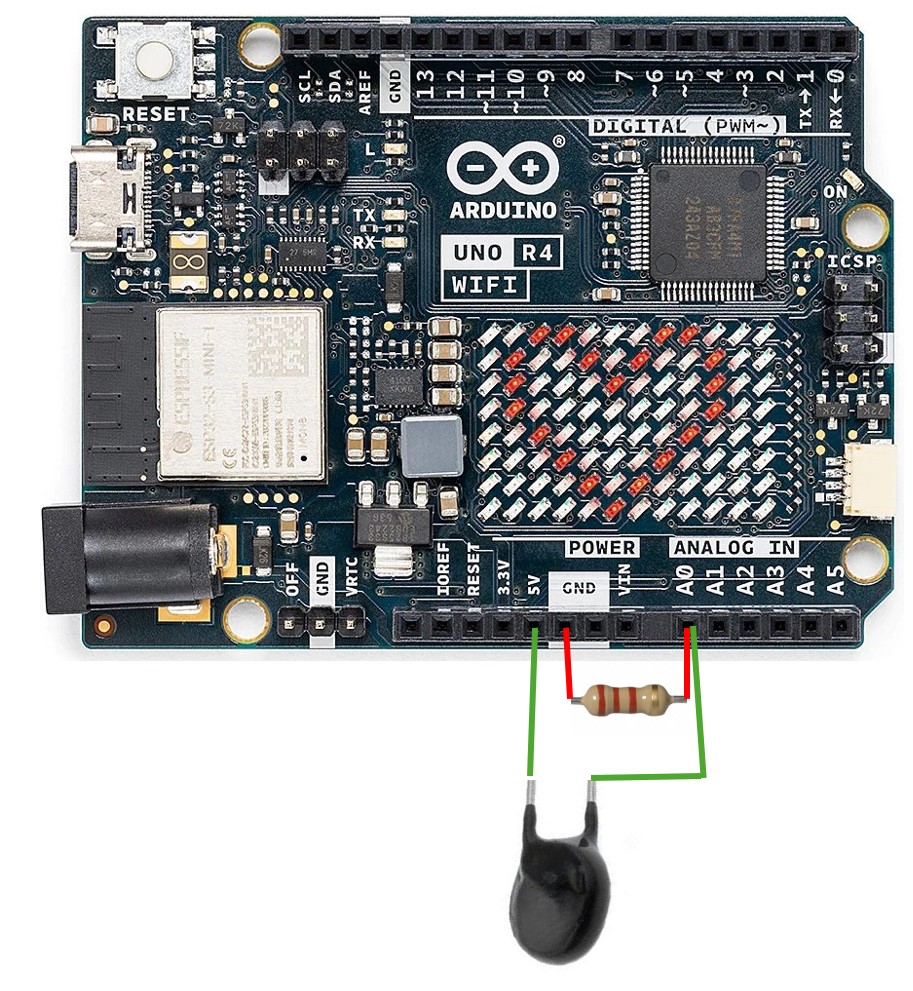
Mechanical assembly:
- Connect the thermistor to pins 5V and A0
- Connect 2 kOhm resistor to pins A0 and GND
Arduino coding.
There are three areas of the code:
1. Thermometer:
- Recalculate Arduino levels to temperature by a least square regression method
2. Wifi/networking:
- Connect to your WiFi network
- Establish http/https connection to the server
- Send data in URL
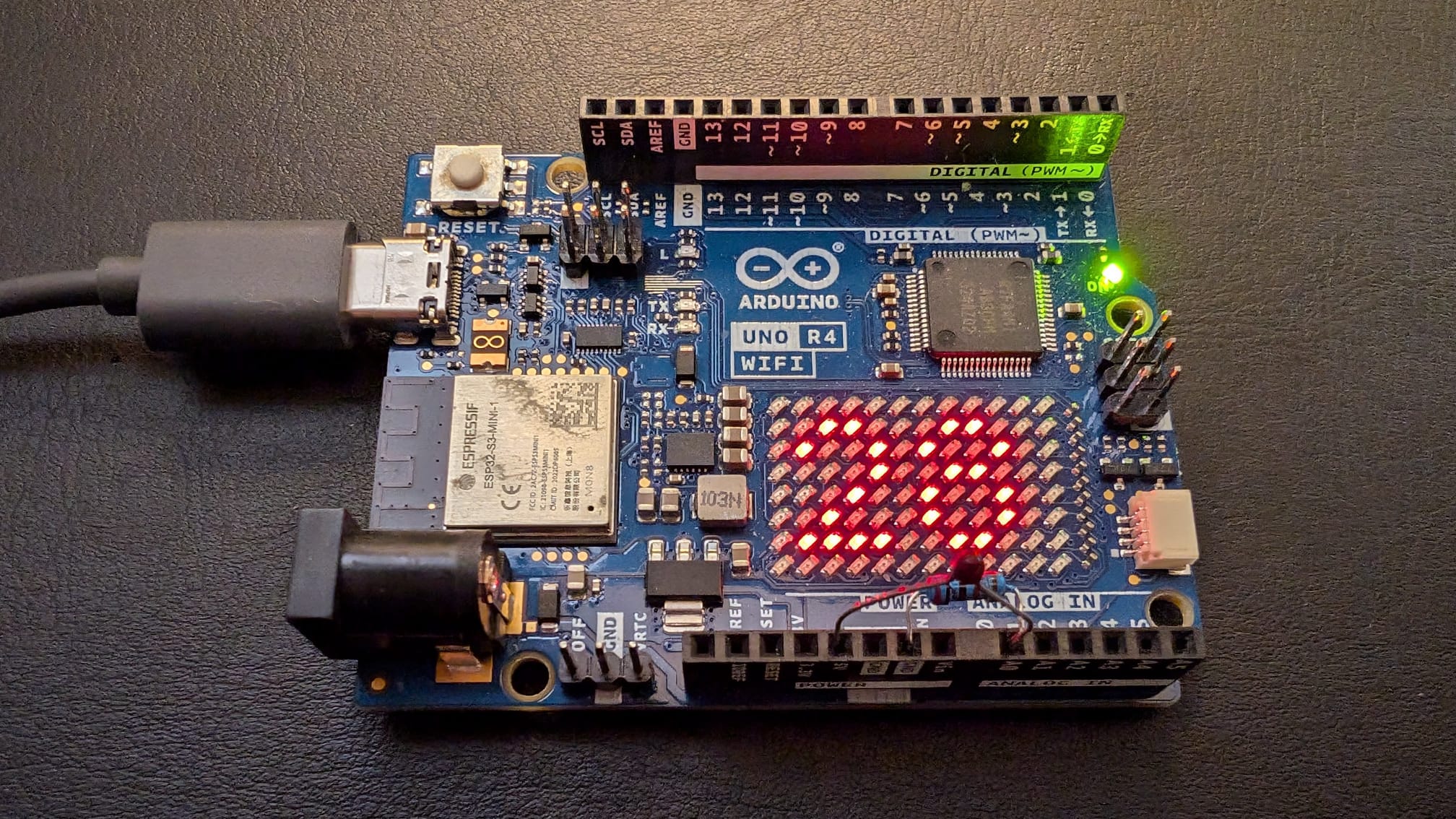
3. Onboard matric LED display
- Display the results on the matrix and scroll the text
The Arduino code is here .
Technical Deep-Dive
- Thermistor Regression & Multi-Point Calibration Forensics:
- The Least-Square Regression Analytics: Unlike linear sensors, thermistors exhibit non-linear NTC (Negative Temperature Coefficient) harmonics. Forensics involve a manual calibration sweep (Cold/Ambient/Hot). The diagnostics focus on the
levels[]andtemperature[]arrays, using regression heuristics to map analog raw-data to precision Celsius gradients with high-fidelity repeatability. - Voltage-Divider Signal-Integrity: The circuit utilizes a $2\text{k}\Omega$ reference resistor. Forensics involve monitoring the $A0$ node relative to the $5\text{V}$ rail-stiffness, ensuring that thermal-induced impedance changes are captured with maximum bit-resolution before WiFi-packet ingestion.
- The Least-Square Regression Analytics: Unlike linear sensors, thermistors exhibit non-linear NTC (Negative Temperature Coefficient) harmonics. Forensics involve a manual calibration sweep (Cold/Ambient/Hot). The diagnostics focus on the
- WiFi-Link & Cloud-Telemetry Orchestration:
- HTTP-GET Bitstream Diagnostics: Data is serialized into a URL-encoded string $(\text{Secret-Key + Value})$. Forensics involve establishing a secure link to
2minlog.com. The diagnostics focus on the "Signal-Stiffness", ensuring that the asynchronousHttpClientrequest does not stall the visual-matrix update loops during high-latency network harmonics. - Scrolling-Matrix Visual Logistics: The Uno R4 WiFi's LED matrix provides immediate HMI. Forensics involve the
Arduino_LED_Matrixlibrary, using frame-buffer diagnostics to scroll the current temperature-string with deterministic speed and clarity, providing a localized visual-anchor for the cloud-telemetry stream.
- HTTP-GET Bitstream Diagnostics: Data is serialized into a URL-encoded string $(\text{Secret-Key + Value})$. Forensics involve establishing a secure link to
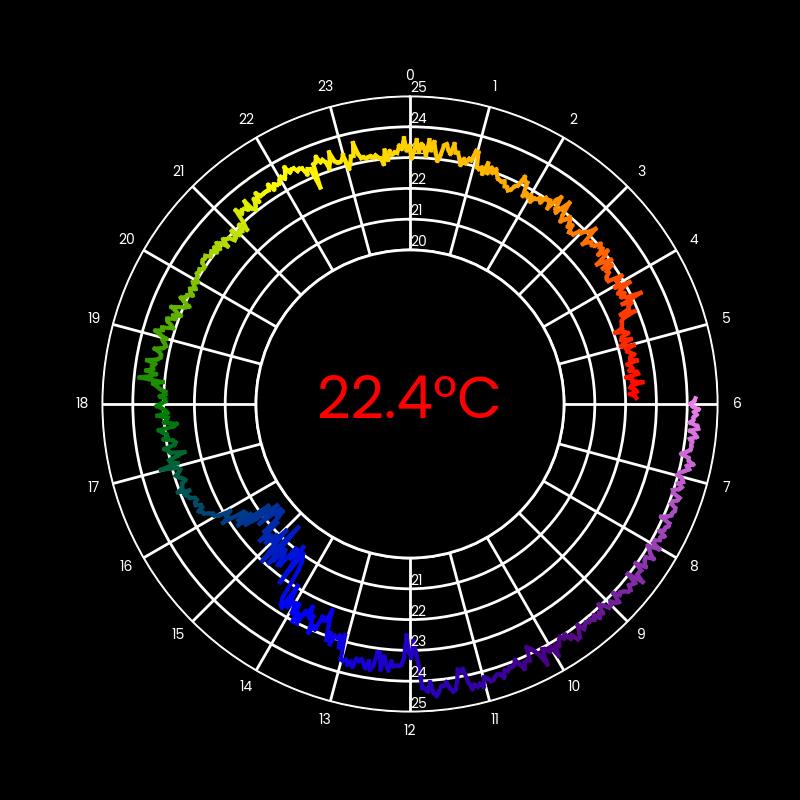
Create and display the graph
- Login to the 2MINLOG system
- Setup the dataset (you will need to input the secret string to Arduino)
- Set up the graph
- Python code for the graph is here .
Engineering & Implementation
- Network-Layer Persistence Forensics:
- Reconnection Heuristics: In the event of an Access Point (AP) failure, the system implements a recursive WiFi-reconnect diagnostic. Forensics focus on the SSID-handshake timing to minimize data-packet loss in the 2MINLOG temporal dataset.
- Cloud-side Data Orchestration: The implementation utilizes Python-based visualization. Forensics involve the
server.pyand2minlog-examplescodebase, ensuring that the cloud-ingested data-packets $(\text{Dataset ID})$ are correctly parsed into historical graphs for multi-device tablet-telemetry.
- Hardware Modularity & Structural Integrity:
- The assembly is compact, relying on the R4's integrated peripherals. Forensics focus on the thermal-isolation of the thermistor from the MCU's own heat-emission harmonics $(\text{on-board WiFi chip})$, ensuring that the detected ambient-gradient is not biased by internal silicon-thermodynamics.
You must calibrate the system, i.e., relate the voltage level to the temperature. Measure hot, cold, and ambient temperature with a reference thermometer. Adjust temperature[] and levels[] arrays in the Arduino code.
Once done, you can display the graph as a home page or use, e.g., an old Android tablet .
(If you do not want to use the 2MINLOG platform, you can set up a local server. The code is here .)
Step-by-step instructions are here .