Multiple RGB Led Chaser
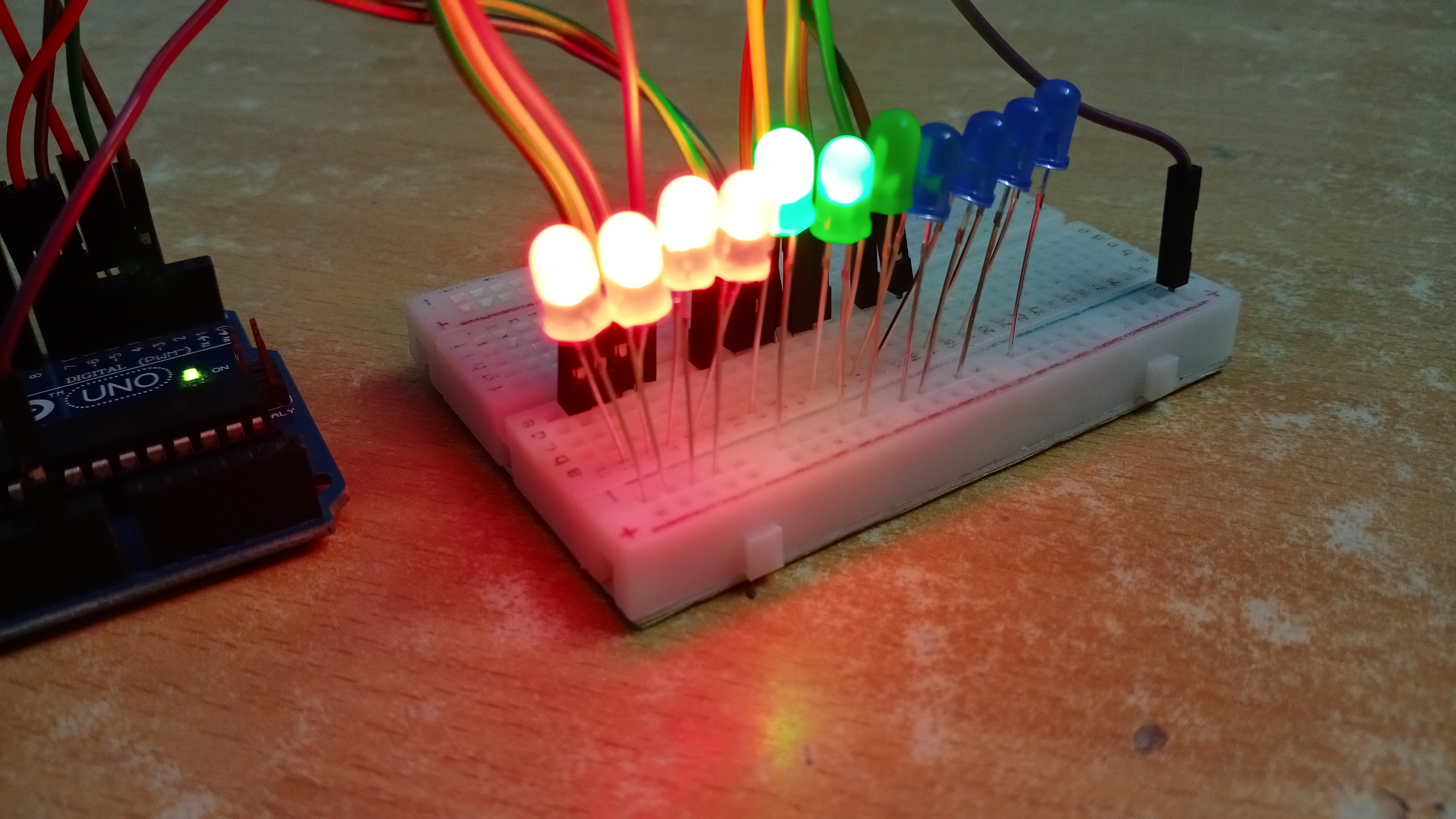
This Project Is about Build RGB LED chaser using arduino,
visit sparkbuzzer Press Here,
🛠️ เจาะลึกเบื้องหลังการทำงาน (Deep Dive / Technical Analysis)
A standard LED blink is entirely binary (On/Off). An RGB LED Chaser incorporates the terrifyingly complex spectrum of light manipulation! The Arduino Uno does not simply toggle a pin; it utilizes massive analogWrite() PWM (Pulse Width Modulation) commands simultaneously across three distinct color channels (Red, Green, Blue) across multiple independent RGB packages! The code aggressively iterates through massive integer arrays, forging a visually intense "Knight Rider" or "Cylon" scanning effect completely colored in customized gradient blends!
Pulse Width Modulation (PWM) Fading Matrices
To make an RGB LED turn "Purple", you can't just send 5V. You MUST blend 100% Red and 50% Blue!
- Only Arduino pins with a physical Tilde (
~) next to the number (e.g.,~3, ~5, ~6, ~9, ~10, ~11) contain the hardware Timer modules required to execute PWM! - The
analogWrite()function chops the 5V signal into hundreds of tiny ultra-fast slices natively. - The Logic: To create a dynamic sweeping chaser, the code executes overlapping
forloops explicitly ramping color channels violently up and down!
int redPins[] = {9, 6, 3};  // Must use PWM pins!
int bluePins[] = {10, 5, 11};

void loop() {
  for (int j = 0; j < 3; j++) {
    // Ramp UP the Red Channel!
    for (int i = 0; i < 255; i += 5) {
      analogWrite(redPins[j], i);
      delay(5); // The fluid fade speed!
    }
    // Violent swap instantly to Blue!
    analogWrite(redPins[j], 0);
    analogWrite(bluePins[j], 255);
    delay(100);
    analogWrite(bluePins[j], 0); // Shut it off to prepare for the next physical LED!
  }
}
Exploring Common Anode vs Common Cathode
Wiring physical RGB LEDs is a massive trap for beginners.
- Common Cathode: The longest leg of the LED connects to
GND. You send 5V (analogWrite(255)) to turn a color ON. - Common Anode: The longest leg explicitly requires
5V. You must pull the color pins completely into the Ground state (analogWrite(0)) to turn them ON! The Arduino Logic is completely inverted! - Supplying raw 5V to an RGB LED without a 220-Ohm current-limiting resistor perfectly aligned to each specific color pin will instantly explode the delicate blue and green semiconductor crystals!
Visual Infrastructure Loadout
- Arduino Uno/Nano (Crucially utilizing its 6 native hardware PWM pins).
- 3x or more RGB LEDs (5mm or 10mm diffused models are vastly superior to clear lenses for blending complex color gradients natively in the plastic!).
- 9x 220-Ohm Resistors (Crucial: Red actually operates on 2.0V, while Blue operates on 3.2V. Professional engineers use differing resistors, like 330-Ohm for Red and 220-Ohm for Blue, to perfectly balance the White chromaticity physically!).
- Note: If expanding to more than 2 RGB LEDs, you run entirely out of Arduino PWM pins completely! This directly necessitates upgrading the architecture into a WS2812B NeoPixel single-wire matrix!